Binance doesn’t allow any of it: verifying an account for someone else, lending out an account you’ve verified, or selling one. The Terms of Use require an individual user to keep the account for their own use and not to use it on behalf of any third party, and the verification help page states that an account can’t be transferred to another person. When something goes wrong, the account that gets restricted or closed is the one in your name, and the bank card linked to it and your identity details are pulled into someone else’s transactions along with it. If the account is already out of your hands, the first job is to lock it.
Binance Terms of Use clauses on lending or selling an account
Binance’s blog post on account selling scams puts it in one sentence: “According to Binance’s Terms of Use, selling accounts is prohibited and can lead to banning or further consequences.” In the Terms themselves, three clauses deal with it:
- Clause 7.2, on who the account is for: an individual user uses the Binance account only for themselves and not on behalf of any third party, unless Binance has given written consent beforehand. The clause ends by making you fully responsible for all activity on your Binance account.
- Clause 9.2, on third-party access: any Binance account registered in your name is not to be used by anyone other than you.
- Clause 36.5, on assignment: without Binance’s prior written consent, you can’t assign or transfer any of your rights or obligations under the Terms.
Binance’s help page How to Complete Identity Verification for a Personal Account carries a note of its own, under the question about updating identity information: “You cannot transfer your account to another person or substitute another person’s ID for your ID.”
Set against what actually gets done: passing verification for a friend and giving them the account runs into 7.2 and 9.2; taking money for a verified account adds 36.5 and the note on the verification page; lending out nothing but the login password for a few days is still someone else using your account, which is what 9.2 rules out. The only opening 7.2 leaves is Binance’s prior written consent.
Verifying an account for someone else uses up your one personal account
Verifying an account for someone else means going through the whole process yourself: choosing a place of residence and a document type, uploading the front and back of the ID, doing the face verification, then confirming your personal information. At that last step the help page asks: “Please make sure that all the information entered is consistent with your ID documents.” The sentence right after it is “You won’t be able to change it once confirmed.” Once verification passes, the account is yours as far as Binance is concerned; the name, the document number and the face all point to one person, and that person is you.
How many verified personal accounts one person can have is answered directly in the FAQ on the same page. If you already have a verified personal account, the options given are a separate entity account, or the sub-account feature, which allows up to 5 sub-accounts under your personal account; a second verified personal account isn’t among them. With that one slot spent on an account in someone else’s hands, a later attempt to open one for yourself may be told at verification that the ID has already been used, while the old account that could be recovered is held by the other person.
Doing a further face verification for the account after it has been handed over means putting your face forward to get an account someone else is running through an identity check. Under clause 7.3 of the Terms of Use, the identity you authorise Binance to verify, directly or through third parties, is your own, as a guard against fraud, money laundering, terrorist financing and other financial crime. The person who passed verification is you and the person using the account is someone else, so the two no longer match, and Binance may take whatever action it considers necessary in light of the results.
Why does the bank account get frozen when it’s handed over with the Binance account?
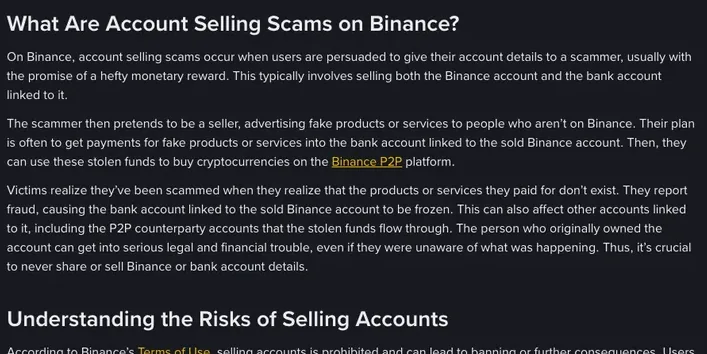
The buyer is after more than a Binance account. Binance’s blog says of these deals: “This typically involves selling both the Binance account and the bank account linked to it.” After taking over, the scammer poses as a seller, advertises products or services that don’t exist to people who aren’t on Binance, has them pay into that bank account, then uses the money to buy crypto on Binance P2P.
Those who paid find out there was never anything to receive, and they report the fraud. The blog goes on: the bank account linked to the sold Binance account is frozen as a result, and other accounts linked to it can be affected too, including the P2P counterparty accounts the stolen funds pass through. The original account holder can end up in serious legal and financial trouble even without knowing any of this was going on.
The blog sorts the consequences of selling an account into four kinds:
| Consequence | How the blog describes it |
|---|---|
| Legal issues | The original account holder can be drawn into legal disputes, face severe penalties, or even be formally prosecuted for alleged involvement in fraud |
| Frozen accounts | The bank may stop all activity on the bank account involved and on others linked to it, which interrupts everyday payments |
| Monetary losses | Fines, plus legal expenses from court cases or investigations |
| Identity theft | The scammer can exploit the personal details on the account to pass as you |
What does Binance do when an account isn’t being used by its owner?
The power to act sits in clause 20.1 of the Terms of Use. Binance may refuse to complete a transaction or cancel it; terminate, suspend or restrict your use of any or all of its services; terminate, suspend, close, hold or restrict your access to any or all of your Binance accounts; refuse to transmit information or instructions to third parties; and take any other action it considers necessary. The clause provides that each of these takes effect immediately.
Of the grounds 20.1 lists, these bear directly on lending and selling:
- Binance reasonably suspects that the person logged in to your account is not you, or that the account has been or will be used for illegal, fraudulent or unauthorised purposes;
- more than one natural person accesses or uses the same Binance account to trade;
- Binance determines or suspects that you have breached the Terms;
- your account, or your use of Binance’s services, involves money laundering, terrorist financing, fraud or other crime;
- use of the account is subject to litigation, an investigation, or judicial, governmental or regulatory proceedings.
Once the account is restricted, any instructions, positions or open trades still outstanding may be closed out by you or by Binance under clause 20.3. Clause 20.4 deals with a separate matter: where Binance is informed and reasonably believes that digital assets or fiat in the account are stolen, or otherwise not lawfully yours, it may freeze the affected funds and the whole account until you produce evidence, acceptable to Binance, that you’re entitled to them.
You may never learn which ground the account was shut on. Clause 20.2 provides that decisions of this kind can rest on confidential criteria essential to risk management and security, and that Binance is under no obligation to disclose the details of its risk management and security procedures to you.
Damage control for a Binance account already lent out or sold
Clause 16.4 of the Terms of Use sets out what you must do when you suspect the account’s security has been compromised. Put together with the blog’s advice, the order is:
- If you can still log in, lock the account at once. Clause 16.4 requires you to lock your Binance account immediately, through the platform’s disable-account function or any other method Binance prescribes from time to time. Before locking it, don’t move coins or place orders for the other person; afterwards, if they ask you to help unlock it or redo verification, don’t go along with it.
- Contact Binance support and explain what happened. Clause 16.4 requires you to notify Binance immediately and to keep providing accurate, up-to-date information for as long as the matter runs. Support is reached through 24/7 Chat Support, in the Support column of the footer on Binance’s website. Open with the essentials: the account was verified with your ID, when it was handed over and to whom, and whatever you know the other person did with it.
- Tell your bank. The blog’s advice is to alert the bank immediately if the account seems compromised, because quick action keeps the damage down. Name the bank card linked to this Binance account specifically.
- Once the account is back in your hands, change the password and turn on two-factor authentication. Clause 16.2 makes a strong password your own responsibility, and the blog also recommends updating credentials frequently and enabling 2FA. The same clause adds that Binance will never, under any circumstances, ask you to share your password or two-factor authentication code.
- Go through the account history line by line. Clause 10.1 requires you to review the records carefully and, within 14 days of the date the account history was made available to you, to tell Binance about any record or transaction you don’t recognise or believe is incorrect. Mark every deposit, trade and withdrawal you don’t recognise from the period the other person had the account, and pass them to support.
If you can’t log in any more, for instance because the other person has changed the password or the linked email or phone number, support is the only route left; explain whose account it is in the way step 2 describes. Supply whatever support asks for: clause 7.4 gives Binance the right to require additional information, extra records or documents, or even a face-to-face meeting with a Binance representative, and under clause 8.3, if you refuse to provide information or don’t provide it promptly, Binance may suspend or terminate your access to the account immediately and without notice.