“Binance is asking me to prove where my money came from.” Two different questions hide behind that sentence. Source of wealth is how you came to have money at all; source of funds is where one particular deposit came from. Two answers, two sets of paperwork, and most of the trouble people have here comes from answering the first one when they were asked the second.
Two questions wearing one name
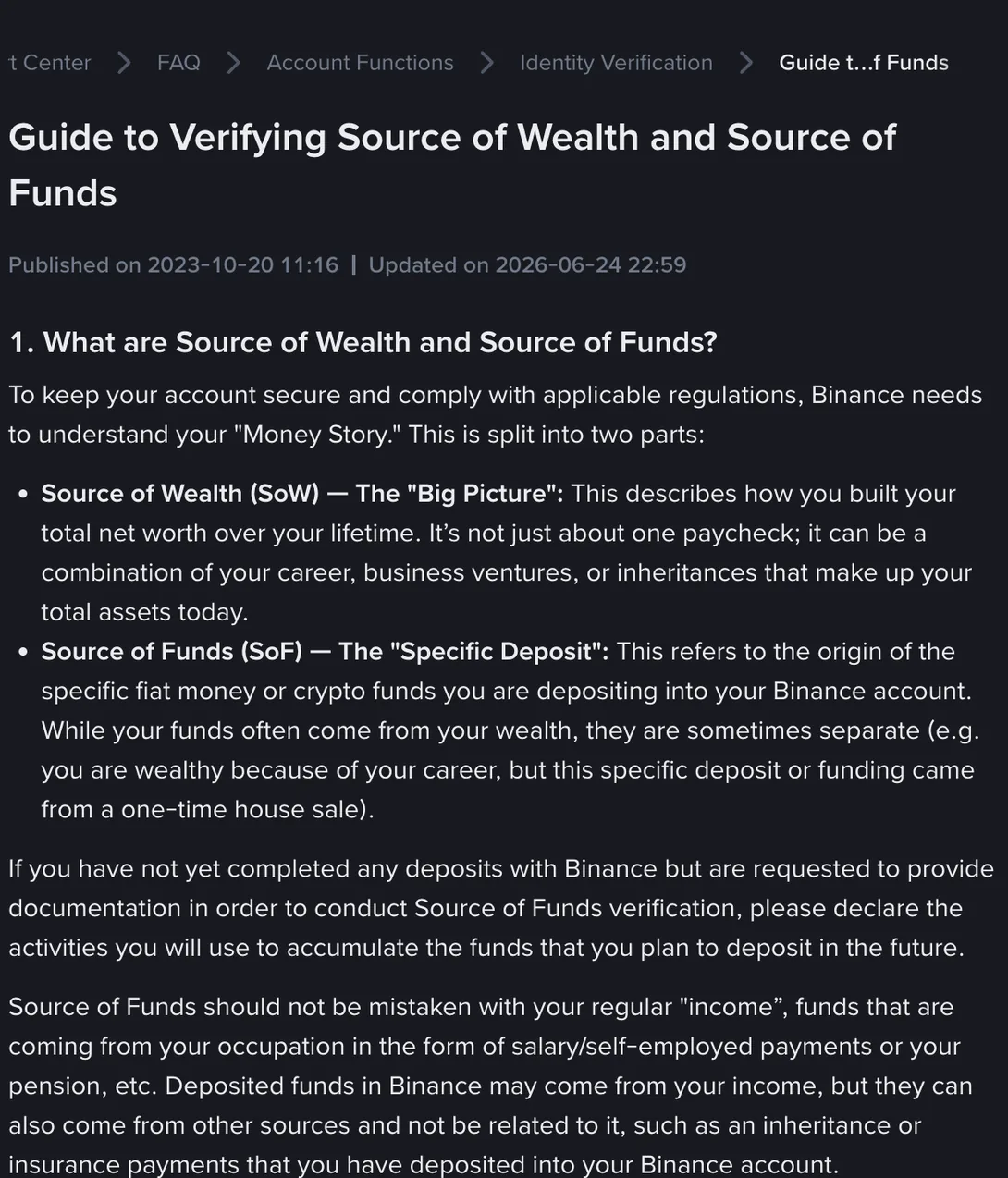
The official guide introduces the whole subject with a phrase that is more useful than the acronyms: it says Binance needs to understand your Money Story, and that this is split into two parts. Then it labels them, and the labels carry their own summaries.
Source of Wealth (SoW) — The ‘Big Picture’
Source of Funds (SoF) — The ‘Specific Deposit’
The big picture is a history: twelve years in one industry, a flat sold in 2021, a share of an inheritance. The specific deposit is a route: this money sat in that account since March, and on Tuesday it moved here. One is a biography, the other is an itinerary.
Read the message you were sent and work out which of the two it wants. If it names a deposit, with a date and an amount, it wants the itinerary. If it asks about your occupation, your income and how you built up what you hold, it wants the biography. Sometimes it asks for both, in which case answer them as two separate things rather than blending them into one long paragraph.
There is a case the guide handles explicitly, and it catches people out because it seems backwards. You can be asked about funds before you have deposited anything. The page says that if you have not yet completed any deposits with Binance but are requested to provide documentation, you should declare the activities you will use to accumulate the funds that you plan to deposit in the future. Nothing has gone wrong when that happens; you are being asked for the plan rather than the history.
Nothing on the page says what sets this off
I went looking for a list of triggers, because that is the first thing anyone wants when this lands in their inbox. It is not there. The help page explains what the two terms mean, why they are asked for and what documents are wanted, and it does not publish the circumstances that produce the request. Any article that gives you a threshold amount is telling you something Binance has not said, and thresholds are exactly the sort of thing that varies by country and gets adjusted without an announcement.
What can be said without inventing anything is the shape of the machinery. Anti-money-laundering rules oblige a regulated platform to know both ends of a transaction: who holds the account, and where the value came from. Identity verification answers the first. This request answers the second. Being asked is not an accusation, and in a system built to check everybody in order to find very few, being asked is not even unusual.
How often this comes up, and what will satisfy it, is not the same in two countries. Residents of some places meet this request far more routinely than others, and local fiat deposit and withdrawal channels carry requirements of their own on top of it. None of that stays fixed, and nothing on this page is advice, legal or financial.
Why is your salary often the wrong answer?
The guide anticipates the obvious first reply, and heads it off in a single line: source of funds should not be mistaken with your regular income.
That sentence is doing real work. Your salary answers a question about capacity, which is whether someone in your position could plausibly have accumulated this. It does not answer the question about route, which is where this particular money was sitting before it moved. The two come apart constantly, and there is nothing suspicious about them coming apart.
| Where the deposit came from | Why income alone does not explain it |
|---|---|
| Sale of a property or a vehicle | The amount is nothing like your monthly pay, because it is a one-off conversion of an asset you already owned. |
| A gift or an inheritance from family | You did not earn it. Describing your own earnings answers about someone else’s money. |
| Dividends, a share sale or exercised options | A separate channel from payroll, with a separate set of documents behind it. |
| Money you withdrew from an exchange earlier and have now sent back | Your own funds making a return trip. The path matters more than the figure. |
| Repayment of a loan you made to a friend | The hardest to evidence. Without the original transfer and some written record, there is nothing to point at. |
So what you are writing is a route, not a figure. In practice the sentence takes this shape: this money came from a particular event on a particular date, it sat in a named account from then until now, and on this date it moved to Binance. Concrete event, concrete resting place, concrete dates. Adjectives about being a legitimate earner add nothing.
What to gather, by where the money came from
The same guide carries on into a third and fourth section, which set out the document requirements and what counts as acceptable. Those run past the part of the page I have a screenshot of, so I am not going to paraphrase them here. Open the guide and read them yourself, because the version live on the day you are asked is the one that governs. What follows is the practical grouping by situation, which changes far less often.
| If the money came from | Bring |
|---|---|
| Employment | Recent payslips, plus the bank statements that show those payments arriving and the balance building up. |
| Self-employment or a business | Your annual tax return and the business accounts for the same period, plus statements from the account the money actually sat in. |
| Sale of property or another asset | The sale agreement or contract, and the bank record of the proceeds landing. |
| Inheritance or a gift | The legal document behind it, together with the transfer record showing the money reaching you. |
| Another exchange or platform | The trade and withdrawal history from that side, matched to the deposit on this side. |
Whatever the category, the test is the same one: every leg of the route you describe should have a document sitting under it. A missing document is not the only way to fail this; a set of documents that disagree with each other fails just as surely. The statement says March, the bank record says May. The statement says a property sale, the contract carries a relative’s name. Nobody on the review side does detective work to reconcile that; a mismatch simply comes back, usually without telling you which line caused it.
Before sending anything, read your own statement and put a finger on each date, each amount and each institution in the files you are attaching. Anything you cannot point at is either a missing document or a sentence that needs rewriting.
My own preference, which is a habit rather than a rule: send whole original PDFs rather than screenshots. A downloaded statement arrives complete, with the issuer, the dates and your name already on it, and there is no argument to be had about what got cropped out.
What the page does not say about refusing
I looked for this too, and it is worth being plain about the result: the help page does not describe what happens if you do not provide the documents. No consequences are listed. So I am not going to tell you that your account gets closed, or frozen, or restricted, because that would be me writing a rule Binance has not published.
What follows from the structure rather than from any statement is narrower. A request for documents sits in the path of whatever prompted it, and until it is answered, that thing does not move forward. How that shows up varies by account and by country, and I have no basis for turning that into a list.
The one thing I would say with confidence is about silence. If a deadline is attached and you cannot meet it, replying to say what you are gathering and roughly how long you need is a different position from not replying at all. It costs a few minutes and it keeps the conversation open.
A follow-up question after you have answered is also normal and is usually not a verdict on your first reply. It generally means one leg of the route needs a document that was not attached. Answer that leg. Resist the urge to resend everything, and resist the urge to add three more years of statements for good measure, because every extra document is another surface that has to agree with all the others.
The first sentence you write
Start with the event, not with yourself. Not I have been working for many years and my income is legitimate, which answers nothing, but something with a shape like: this deposit is the proceeds of a flat sold in March 2024, which have been held in my savings account at the same bank since then. One clause for the origin, one for where it waited.
Everything else you attach is there to support that sentence. Write it first, then go and find the documents that prove each half of it, in that order. Doing it the other way round, gathering everything you can lay hands on and hoping the story assembles itself, is how people end up submitting files that contradict one another.
One sentence, then the paper that holds it up. That is the whole method.