Binance puts an estimated time of 15 mins on the screen you see immediately after submitting. Binance also says, in the frequently asked questions at the foot of the same help page, that submitted documents are usually reviewed within 48 hours. Both of those come from Binance, neither is a typo, and the gap between them is the reason this page exists.
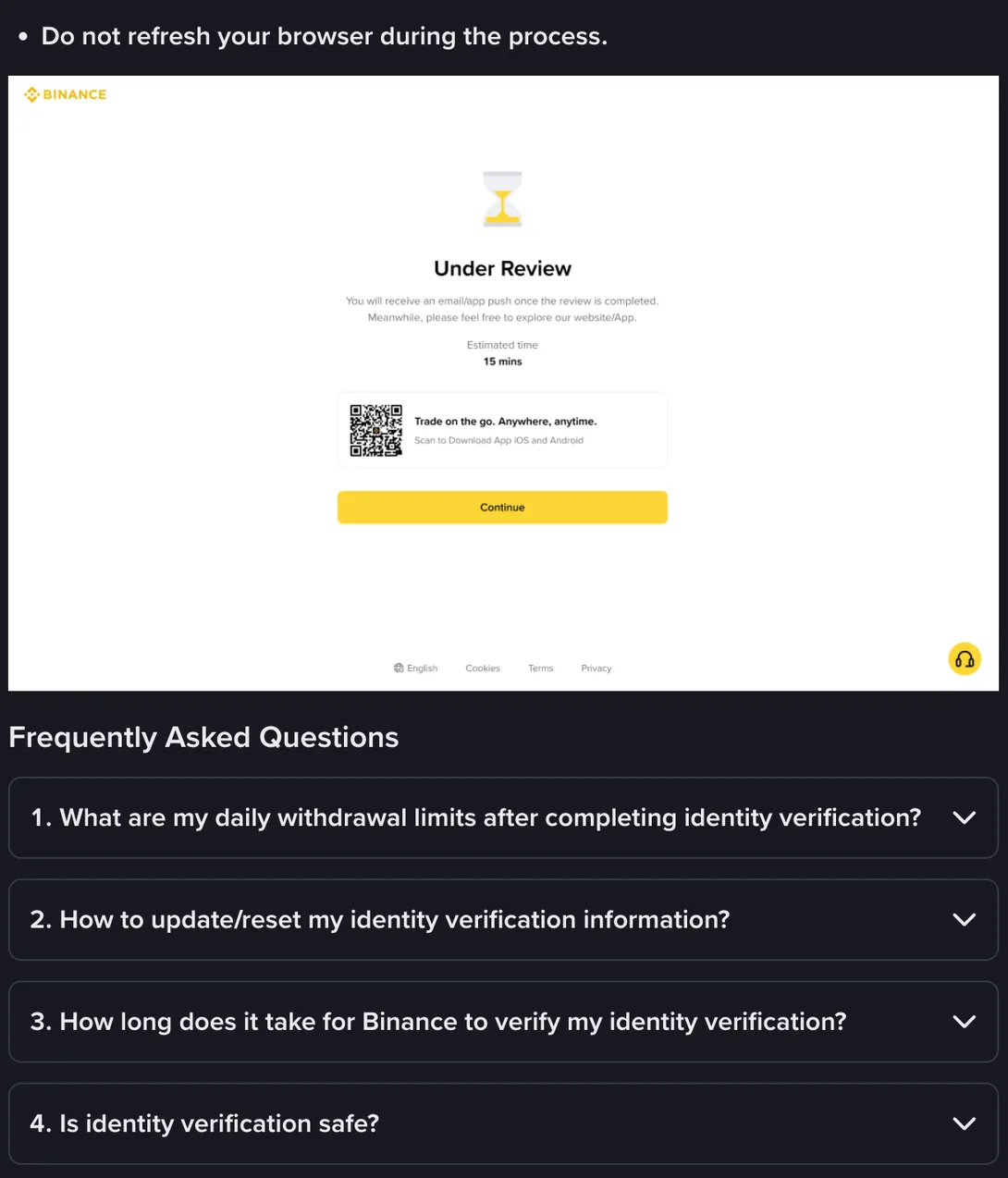
Two numbers, two different questions
The word doing the work on that screen is estimated. It is the interface giving you a figure for the case you have just submitted, in the way a progress bar gives you a figure: useful, not binding. Nowhere does it say a result is promised in a quarter of an hour.
The 48 hours lives somewhere else entirely. It is the third item in the frequently asked questions at the bottom of the verification help page, and it reads in full:
Submitted documents are usually reviewed within 48 hours. However, it may take longer in some particular cases.
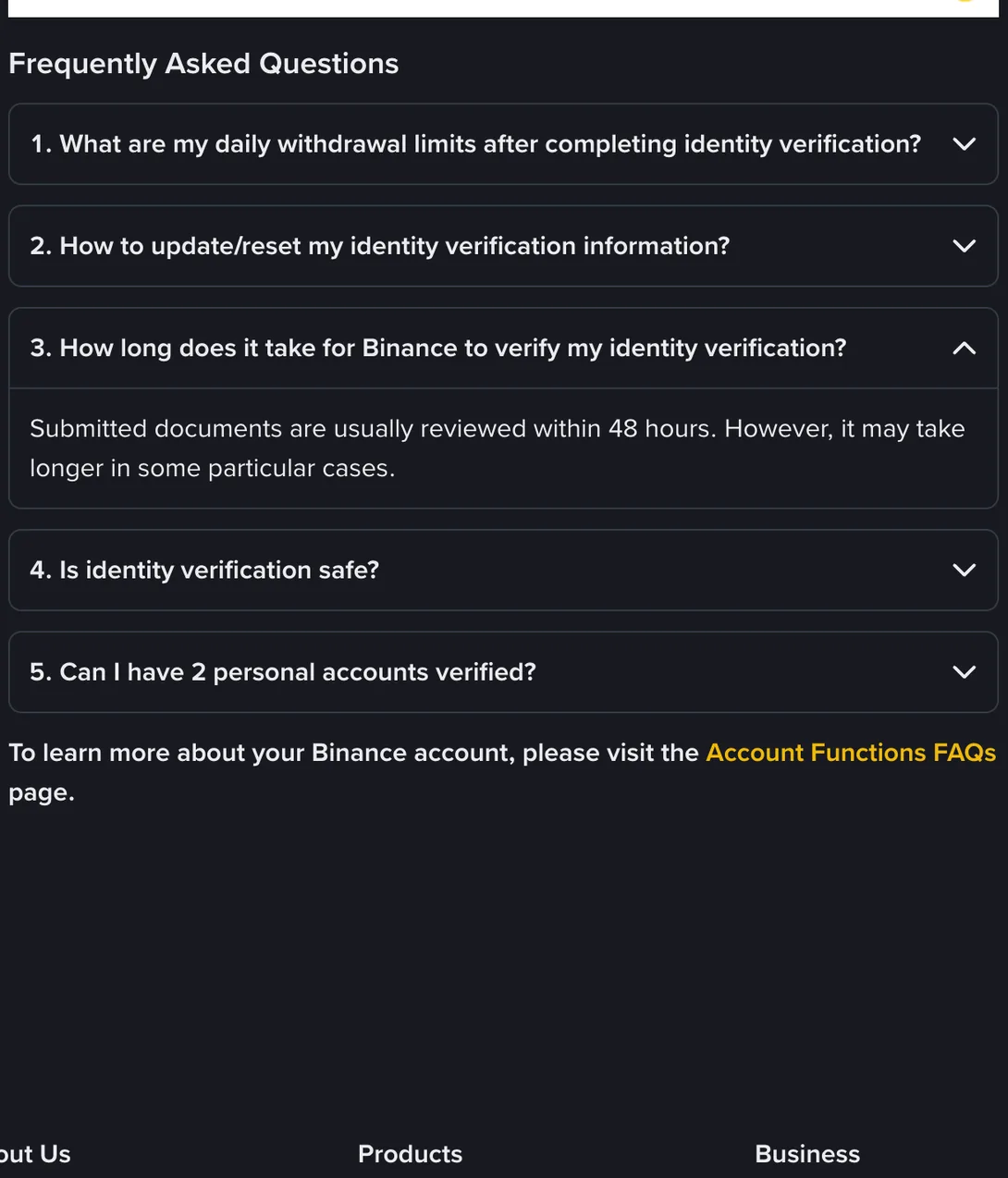
Read them side by side and the disagreement disappears. One is a live estimate for your case; the other is the platform describing the usual range for cases in general, with an explicit tail for the ones that are not usual. There is no average of 15 minutes and 48 hours worth calculating, and any page offering you a third number, two to ten days being the popular one, is offering something neither Binance nor anyone else has published.
The sentence also splits its readers into two groups. If you are inside 48 hours, you are in the first half and there is nothing to do. If you are past it, you are in the tail the second half describes, and the second half does not come with a number attached. That is where the last section of this page starts.
What tends to come before a longer wait
Nobody outside Binance can tell you how cases are routed, and this site will not pretend otherwise. What can be said usefully is which submissions give a reviewer, human or otherwise, more to resolve. Anything that has to be resolved takes time that a clean case does not spend.
A document that is hard to read comes first. A band of glare across the number, a corner out of frame, a photograph taken in a dim room, and now the characters are a judgement call rather than a reading. The same applies to the liveness recording: backlight, a slow connection, a video that restarts twice.
Then anything where two of your own answers do not sit neatly together. A name that transliterates several ways and was typed one way and printed another. A date of birth entered day-first into a year, month, day selector. A residence in one country and a document issued in another, which is entirely normal and still an extra thing to reconcile. An address document close to the edge of its validity period.
Then the cases that are simply less common: an unusual document type, a document that has appeared before, several submissions in quick succession, an account with something else outstanding on it.
None of that means your case is in trouble. It means your case has more surface area, and surface area costs hours. The counterpart is worth saying too, because it changes what you do next time: photographing a document properly is not only about avoiding a rejection, it is about not being interesting.
Do these things while it sits there, and leave the rest alone
There is a short list of things worth doing in the first ten minutes after submitting, and after that the correct amount of activity is close to zero.
Do check that a result can reach you. The Under Review screen says you will get an email or an app notification when the review completes, so look in your spam folder now, while nothing is urgent, and check that notifications for the app are actually switched on. A meaningful share of people who believe they are still waiting have already been answered.
Do keep the files you submitted. If the case comes back, having the exact images to hand is the difference between diagnosing the problem and guessing at it.
Do not upload the same documents again while the case is under review. An identical resubmission gives the reviewer nothing new to look at, and it can lift your case out of wherever it currently sits. If nothing about the material has changed, there is nothing to gain by sending it again.
Do not open a second account to try your luck there. Binance’s own list of questions on that page carries one titled “Can I have 2 personal accounts verified?” as its fifth item; it is collapsed in the screenshot above and I am not going to guess at the answer. What needs no guessing is that a second account does nothing for the case already in the queue, and that the same document appearing twice is exactly the sort of thing an identity check is built to notice.
Do not clear cookies, switch browsers and walk back through the flow to see whether it still remembers you. None of that reaches a submitted case, and it can drop you onto an entry point that starts a new one.
While you wait, close the tab and check your email before bed. Refreshing a status screen will not make a queue shorter; it only makes the wait feel longer than it is. And do not spend the wait deciding what to buy the minute it clears, because a cleared verification says nothing whatever about the market behind it, where money can go to zero.
Still pending after several days
Days two, three and four are where people start doing damage, because impatience and a resubmit button are a poor combination. Work through this in order instead.
First, find out what your case actually says, by opening the verification page and reading the current state off it. Not from memory, not from the absence of an email. Under review and rejected can look similar in a hurry, and their next steps are opposites: one wants you to do nothing, the other wants you to change something. If yours has come back, the twelve usual causes are sorted in what a rejection actually means.
Second, if it says under review, check the delivery channels again properly. Spam folder, promotions tab, app notification permissions, and the phone number on the account if it has changed since you signed up.
Third, leave the material alone. There is no interval or attempt limit published on Binance’s help pages that I could find in September 2026, so this site will not invent one, but the practical logic holds regardless: resubmitting unchanged files cannot produce a different reading of them.
Fourth, once you are past the published 48 hours with no result and no notification, opening a support ticket is reasonable rather than pushy. Have four things ready before you start the conversation: roughly when you submitted, which document type you used, the exact line currently showing on your screen, and whether any notification has arrived at all. Specific questions get specific answers; “it has been ages” costs three rounds of messages before anyone can look anything up.
When should you stop waiting?
The line to draw is about the material, not the clock. If you already know something is wrong with what you sent, a blurred number, a corner missing, a name you typed the wrong way round, waiting is just a delayed rejection, and the sooner you are told so the sooner you can fix it. If the material was clean and this is only slow, keep waiting; there is nothing to improve.
In between those, there is one action that is always available and always worth taking: write down what you submitted and when. Document type, the date, the spelling of the name you used, which address document went with it. A second attempt built on a record beats a second attempt built on memory, and how to pace that attempt is a separate page.