A withdrawal page asks for the beneficiary’s name because of a set of rules known as the travel rule. It makes the sender’s service provider hand a few identifying details about the sender and the recipient to the provider at the receiving end, along with the transfer. In the EU version, the details sent about the recipient are the name, the distributed ledger address and the account number; and when more than EUR 1,000 goes to a self-hosted address, the sender’s provider also has to assess whether that address is owned or controlled by the sender.
The crypto travel rule covers the identity details that providers pass along with a transfer
The travel rule binds service providers. Its obligations sit with the platform that sends your coins out and the platform that takes them in for the recipient, and what you type on the withdrawal page is the material they need to meet those obligations.
The EU wrote this into Regulation (EU) 2023/1113. The regulation deals with the information that has to accompany transfers of funds and certain crypto-assets, commonly known as the travel rule, and the European Banking Authority has issued guidelines to go with it (see its press release).
Scope turns on where the provider is registered. If the crypto-asset service provider, or the intermediary crypto-asset service provider, of either the originator or the beneficiary has its registered office in the EU, the transfer of crypto-assets falls under the regulation. The recitals add that transfers of crypto-assets should be subject to the same requirements regardless of their amount and of whether they are domestic or cross-border.
The regulation’s definition of a transfer of crypto-assets doesn’t depend on whether the originator and the beneficiary are the same person. Moving coins from one platform to your own account on another is still a transfer, and the beneficiary name to enter in that case is your own.
Which originator and beneficiary details does Article 14 require?
The originator’s provider has to ensure that a transfer of crypto-assets is accompanied by two sets of information. Article 14(1) lists the set on the originator, the person sending; Article 14(2) lists the set on the beneficiary, the person receiving.
| Item | Originator | Beneficiary |
|---|---|---|
| Name | Required | Required |
| Distributed ledger address | Required where the transfer is registered on a network using distributed ledger technology (DLT) or similar technology | Required, on the same condition |
| Crypto-asset account number | Required where such an account exists and is used to process the transaction. Where the transfer is not registered on a network of that kind, the account number is what accompanies the transfer | Required, on the same conditions |
| Address, including the name of the country, official personal document number and customer identification number, or, alternatively, date and place of birth | Required | Not part of this set |
| Current legal entity identifier (LEI) or, in its absence, any other available equivalent official identifier | Sent only where the message format has the necessary field and the originator has provided it to its provider | Same conditions, and here too it is the originator who provides it to its provider |
A distributed ledger address is an alphanumeric code that identifies an address on a network where crypto-assets can be sent or received. The receiving address you paste into the withdrawal page is one. A transfer that is neither registered on such a network nor made to or from a crypto-asset account is accompanied by a unique transaction identifier instead.
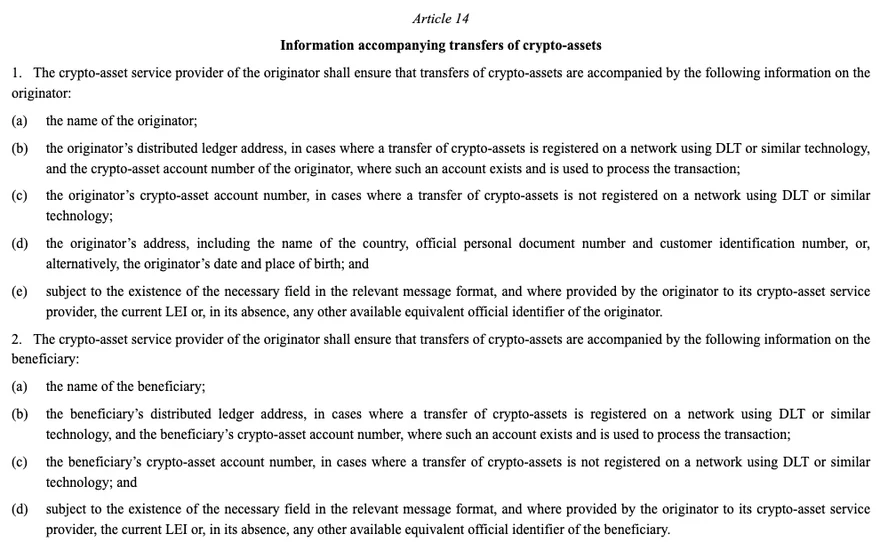
The originator’s set has to be checked before the coins leave: the provider verifies its accuracy on the basis of documents, data or information obtained from a reliable and independent source. Verification is deemed to have taken place where the customer’s identity has already been verified under the EU’s anti-money-laundering directive and the information obtained that way has been retained as the directive requires. For anyone holding an account on a platform, that points back to the identity verification done when the account was opened.
The beneficiary’s set is different: the originator’s provider may not have it, since the person it knows is its own customer. Article 14(2) requires the transfer to be accompanied by the name of the beneficiary, and paragraph 8 bars the originator’s provider from allowing a transfer to be initiated, or executing one, before ensuring full compliance with the article. The beneficiary name box on the withdrawal page collects that item.
Does the beneficiary name you enter get written to the blockchain?
The regulation asks for the information to be submitted. It doesn’t ask for it to be written into the on-chain transfer. Under Article 14, the two sets on the originator and the beneficiary are submitted in advance of the transfer, or simultaneously or concurrently with it, in a secure manner and in accordance with the EU’s General Data Protection Regulation (GDPR); they are not required to be attached directly to the transfer of crypto-assets or to be included in it.
For a single withdrawal, that means the transaction on the chain carries an address and an amount, while the name, the document number and the rest go with the transfer to the beneficiary’s provider.
Withdrawing over EUR 1,000 to your own wallet: why does the platform ask whose address it is?
A self-hosted address is a distributed ledger address linked neither to a crypto-asset service provider nor to an entity established outside the EU that provides similar services. The address of a wallet whose private keys you hold yourself is one of these.
When coins go to an address like that, the originator’s provider has to obtain and hold the two sets of information on the originator and the beneficiary, and ensure that the transfer can be individually identified. A transfer of more than EUR 1,000 adds a step: the provider takes adequate measures to assess whether the address is owned or controlled by the originator.
The opposite direction has a matching provision. When coins arrive at a platform from a self-hosted address, the beneficiary’s provider likewise obtains and holds the two sets; above EUR 1,000, it assesses whether the address is owned or controlled by the beneficiary.
If the withdrawal page, or a notice that arrives afterwards, asks whose address this is, answer with the facts: say it is yours if the wallet is yours, and name the real recipient if it belongs to someone else. The same goes when a platform follows up about your source of funds.
What happens to the coins if the beneficiary details are missing or incomplete?
The beneficiary’s provider is required to have effective procedures for detecting whether the information on the originator and the beneficiary has come with the transfer, including, where appropriate, monitoring during or after it.
Missing or incomplete information is dealt with in Article 17. The beneficiary’s provider needs risk-based procedures for deciding whether to execute, reject, return or suspend a transfer that lacks the required complete information. Once it becomes aware that information required by Article 14 is missing or incomplete, it has to take one of these courses, on a risk-sensitive basis and without undue delay:
- reject the transfer, or return the transferred crypto-assets to the originator’s crypto-asset account;
- request the required information on the originator and the beneficiary before making the crypto-assets available to the beneficiary.
From your side, then, a blank or half-filled entry can show up as coins that are slow to reach the beneficiary’s account, coins returned to the account you withdrew from, or a request for the missing details.
A wrong entry is a separate matter. Before making the crypto-assets available to the beneficiary, the beneficiary’s provider has to verify the accuracy of the beneficiary information on the basis of documents, data or information obtained from a reliable and independent source.
Enter the name the recipient has registered on their account at the receiving platform. Ask them for it letter by letter before you type it; don’t write it from memory, and don’t put your own name in its place. If a request for more details arrives, answer it truthfully.
The regulation and the EBA guidelines have both applied since 30 December 2024
Article 40 sets 30 December 2024 as the date from which the regulation applies. The regulation is directly applicable in all EU Member States.
Other countries and regions have rules of their own. Which items are sent and how self-hosted addresses are treated depend on the local rules and on each platform’s own requirements. If your withdrawal page has one box more or one box fewer than the Article 14 list, go by the page your platform shows at the time.
The European Banking Authority’s guidelines also apply from 30 December 2024. As the press release sums them up, they specify which information should accompany a transfer of funds or crypto-assets, the steps the various providers should take to detect missing or incomplete information, and what they should do if a transfer lacks the required information; the objective is a consistent and effective approach to implementing the travel rule across the EU.