The boxes for account purpose, expected trading volume and occupation all trace back to one requirement in anti-money laundering rules: the platform has to understand the purpose and intended nature of the business relationship. Income isn’t named directly in the relevant provisions of either regulation cited below, so fill that box in truthfully as well. The UK’s Money Laundering Regulations 2017 apply to cryptoasset exchange providers doing business in the UK and require them to assess this and, where appropriate, obtain information on it. Regulation (EU) 2024/1624, the EU’s anti-money laundering regulation, applies from 10 July 2027 and lists the customer’s occupation, the expected amount of activity, the source of funds and the destination of funds among the information to be obtained where necessary.
There’s no need to work out which option looks better. Answer from your real job, where your income comes from and how you plan to use the account, and tell the same story as the documents you have already given the same platform. A cryptoasset exchange provider doing business in the UK also has to keep checking your transactions against what it knows about you after the account is opened, so if the way you use the account changes, update these answers yourself.
The current UK rules and the EU regulation that applies from 2027 both require platforms to understand what your account is for
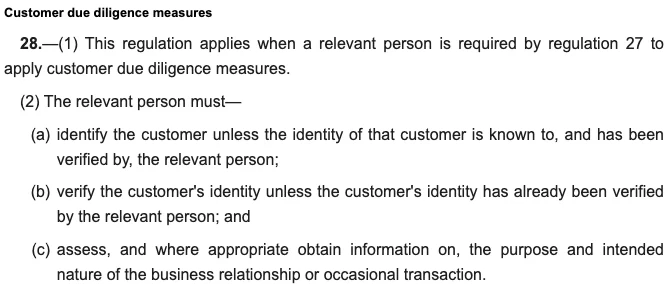
Under regulation 8, the UK regulations cover businesses operating in the UK that fall into the listed categories, and the list includes cryptoasset exchange providers and custodian wallet providers. Regulation 14A defines a cryptoasset exchange provider as a firm or sole practitioner who, by way of business, provides services such as exchanging cryptoassets for money or one cryptoasset for another. The customer due diligence (CDD) steps these firms have to take are set out in regulation 28.
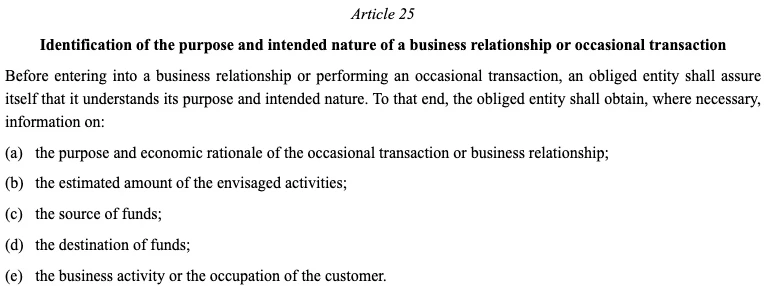
Regulation (EU) 2024/1624 counts crypto-asset service providers among the financial institutions it covers and applies from 10 July 2027. Its Article 25 requires a firm, before it enters into a business relationship or carries out an occasional transaction, to be satisfied that it understands the purpose and intended nature, and to obtain five items of information for that where necessary.
| Provision | What the platform has to understand | Who it covers and from when |
|---|---|---|
| UK Money Laundering Regulations 2017, regulation 28(2)(c) | The purpose and intended nature of the business relationship or occasional transaction: assess it and, where appropriate, obtain information on it | Firms operating in the UK and listed in regulation 8, including cryptoasset exchange providers and custodian wallet providers; in force now |
| Same regulations, regulation 28(13) | Factors to take into account when assessing the risk in a particular case, including but not limited to: the purpose of the account, transaction or business relationship; the level of assets the customer will deposit or the size of the transactions; the regularity and duration of the relationship | As above |
| Regulation (EU) 2024/1624, Article 25 | To be obtained where necessary: the purpose and economic rationale of the transaction or business relationship; the expected amount of activity; the source of funds; the destination of funds; the customer’s business activity or occupation | Obliged entities under the regulation, crypto-asset service providers included; applies from 10 July 2027 |
Are occupation options and income bands set by law?
As far as UK regulation 28 is concerned, the wording that matches the questionnaire is purpose, intended nature, level of assets deposited and size of transactions; the words occupation and income appear nowhere in it. The regulation itself doesn’t say which boxes a questionnaire must have or which occupations it should offer, so answer whichever version your platform shows you at the time.
It also leaves room for platforms to ask in more or less detail from case to case: paragraph (12) says the way due diligence is applied, and how far it goes, must reflect the firm’s own risk assessment and its assessment of the risk in the particular case, and may differ from one case to another.
Occupation appears in point (e) of Article 25 of the EU regulation, which only applies from 10 July 2027, and like the other four points it comes with the condition where necessary.
UK rules require platforms to keep checking your transactions against what they know once the account is open
Under regulation 28(11), a firm must carry out ongoing monitoring of a business relationship, and that covers two things. One is scrutinising transactions throughout the relationship, including the source of funds where necessary, to make sure they are consistent with what the firm knows about the customer, the customer’s business and risk profile. The other is reviewing existing records so that the documents or information obtained for due diligence are kept up to date.
What this paragraph looks at where necessary is the source of funds, meaning where the money used in a transaction came from. A question about how you built up everything you own is about the broader source of wealth.
Article 26 of the EU regulation, applying from 10 July 2027, requires ongoing monitoring along the same lines and, where necessary, a check against information on the source and destination of funds as well. It puts a ceiling on how long customer information can go without an update, with the interval set by the risk of the relationship: at most 1 year for higher-risk customers subject to enhanced due diligence measures, and at most 5 years for other customers. Besides these periodic updates, the information must also be reviewed, and updated where necessary, in situations such as a change in the customer’s relevant circumstances or the firm learning a relevant fact about the customer.
The purpose and expected volume you put in the questionnaire become part of what the platform knows about you. If your actual trading turns out far from them, the platform may ask you to update those boxes.
What happens to an account if you refuse to give your occupation and income?
Whether things get as far as the step below depends on the platform’s judgement, case by case, of whether the information is necessary and whether it can be obtained. Where a platform bound by the UK Money Laundering Regulations 2017 is unable to apply customer due diligence as regulation 28 requires, paragraph (1) of regulation 31 says that it:
- must not carry out any transaction through a bank account with or on behalf of the customer, and must not establish a business relationship or carry out a transaction with the customer otherwise than through a bank account;
- must terminate any existing business relationship with the customer;
- must consider whether it is required to make a disclosure under two UK laws, one on terrorism and one on the proceeds of crime.
If one of the boxes worries you, ask the platform first what it is used for and how the information is kept, and decide what to do once you have the answer.
Fill these boxes in from your real occupation, income sources and planned use
For occupation, put what you actually do now. If you are a student, retired or out of work for the time being, choose the option closest to where you are now. Don’t borrow a former job or a family member’s occupation.
For income, give its real sources and roughly its real level, and when choosing a band, pick the one your actual income falls into.
For account purpose, choose the option that matches what you really intend to do. Estimate expected volume from how much you plan to put in and how often you expect to trade. If you can’t estimate it precisely, answer from your current plan and change it when the plan changes.
Before you submit, dig out the occupation, income and source of funds explanations you gave this platform earlier and check them against what you are about to send. After you submit, note down what you entered this time and keep that record yourself. If you change jobs, your income source changes, or the way you plan to use the account or the amounts involved change, use the record to pick out the items that have changed and contact the platform to update them.