A request for proof of source of wealth (SoW) that arrives after you have already explained your source of funds (SoF) is asking a wider question. The earlier explanation dealt with the money used in one transaction; this one is about how everything you own was built up. UK money laundering regulations list the situations in which a firm doing business there has to check source of wealth.
What does proof of source of wealth ask you to explain?
It asks you to explain how you came by everything you own. The Financial Conduct Authority (FCA), the UK’s financial regulator, describes both terms in the Common terms annex to its financial crime guide. Source of wealth “describes how a customer or beneficial owner acquired their total wealth”, a beneficial owner being the natural person who ultimately owns or controls the customer. Source of funds “refers to the origin of the funds involved in the business relationship or occasional transaction”. The annex describes itself as being for reference purposes.
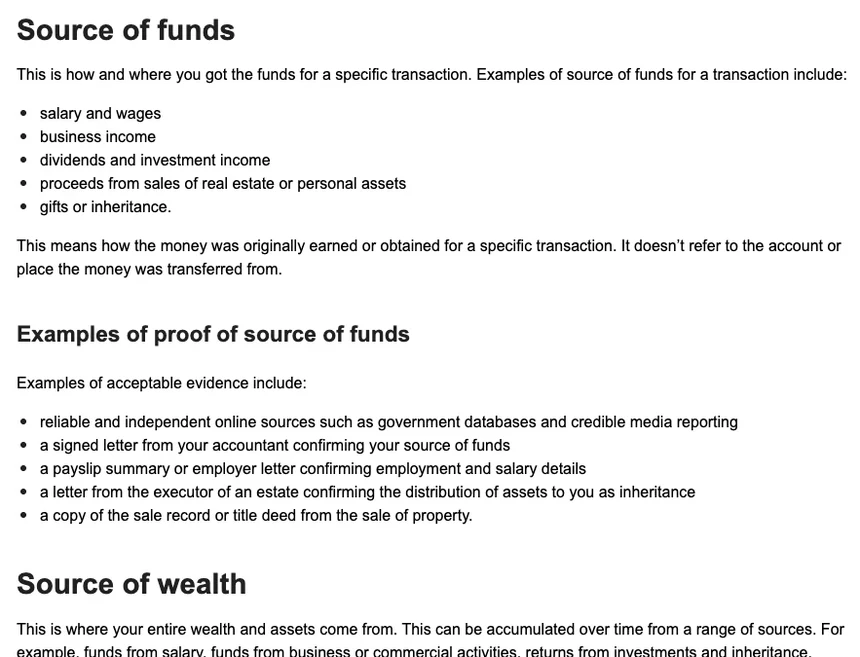
Regulators differ on whether source of funds takes in the route the money travelled. In the FCA annex it covers the activity that generated the funds, for example salary payments or sale proceeds, as well as the means through which the funds were transferred. AUSTRAC, Australia’s anti-money-laundering regulator, tells the public on its guidance page that source of funds means how the money was originally earned or obtained for a specific transaction, and adds: “It doesn’t refer to the account or place the money was transferred from.” When you answer, follow what the notice in front of you asks. If it asks about the route, describe the route as well.
The difference between source of wealth and source of funds comes down to time span and scope
| Point of difference | Source of wealth | Source of funds |
|---|---|---|
| What is asked | Where your entire wealth and assets come from | How and where you got the funds for a specific transaction |
| How far the answer reaches | Wealth accumulated over time, possibly from a range of sources, for example salary, business or commercial activities, returns from investments and inheritance | One specific transaction |
| Acceptable evidence in the Australian regulator’s examples | A signed letter from your accountant confirming your sources of wealth; pay summaries from current and past employers that show wages accumulated over time; a letter from the executor of an estate confirming the distribution of assets to you as inheritance; a copy of the sale record or title deed from the sale of property | Reliable and independent online sources such as government databases and credible media reporting; a signed letter from your accountant confirming your source of funds; a payslip summary or employer letter confirming employment and salary details; a letter from the executor of an estate confirming the distribution of assets to you as inheritance; a copy of the sale record or title deed from the sale of property |
The wording and the evidence examples in the table come from AUSTRAC’s page. It sets out how the Australian regulator interprets Australian legislation, and the regulated businesses it gives as examples are real estate, conveyancing, legal professionals, accountants and financial advisers, with crypto platforms absent from that list. AUSTRAC calls its examples “not exhaustive”. Which documents are actually accepted is settled by the notice from the platform that is asking you.
When does an exchange ask for proof of source of wealth?
Rules on when a platform has to look into source of wealth may be written differently from one place to the next. The UK’s Money Laundering, Terrorist Financing and Transfer of Funds (Information on the Payer) Regulations 2017 list the situations one by one. They apply to “relevant persons” acting in the course of business carried on by them in the United Kingdom, a list that includes cryptoasset exchange providers and custodian wallet providers.
In these regulations a firm’s checks on its customers come in two layers. The standard layer is customer due diligence: identifying the customer, verifying that identity, and assessing the purpose and intended nature of the business relationship. Regulation 28 also requires a relevant person to conduct ongoing monitoring of a business relationship, scrutinising the transactions undertaken in it “including, where necessary, the source of funds”. Higher-risk situations call for a further set of measures on top, known as enhanced customer due diligence, and source of wealth appears in that layer.
Regulations 33 and 35 each describe one situation in which source of wealth is named outright. The first concerns countries on the Financial Action Task Force (FATF) list of High-Risk Jurisdictions subject to a Call for Action. Under regulation 33, a relevant person must apply enhanced measures in any business relationship with a person established in such a country, and in relation to any transaction for which it must apply customer due diligence where either of the parties is established in one. For an individual, being “established in” a country means being resident there, “but not merely having been born in that country”. In this situation the measures must include obtaining information on the source of funds and source of wealth of the customer and of the customer’s beneficial owner.
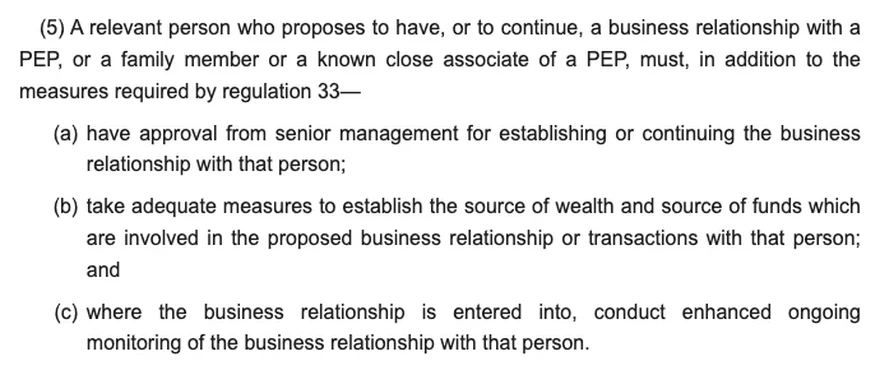
The second is a customer who is a politically exposed person (PEP), meaning an individual entrusted with prominent public functions, other than as a middle-ranking or more junior official. Under regulation 35, a relevant person who proposes to have, or to continue, a business relationship with a PEP, or with a family member or a known close associate of a PEP, must do three things in addition to the measures required by regulation 33: have approval from senior management; take adequate measures to establish the source of wealth and source of funds which are involved in the proposed business relationship or transactions; and, where the business relationship is entered into, conduct enhanced ongoing monitoring of it.
Enhanced due diligence is not confined to those two situations. Regulation 33(1) lists seven:
- any case identified as one where there is a high risk of money laundering or terrorist financing, whether by the relevant person itself or in information made available to it;
- the business relationships and transactions connected with FATF call for action countries described above;
- correspondent relationships with a credit institution or a financial institution, that is, dealings between one institution and another;
- a customer or potential customer the relevant person has determined to be a PEP, or a family member or known close associate of a PEP;
- a customer found to have provided false or stolen identification documentation or information, where the relevant person proposes to continue to deal with that customer;
- a transaction that is unusually complex or unusually large given its nature, an unusual pattern of transactions, or transactions that have no apparent economic or legal purpose;
- any other case which by its nature can present a higher risk of money laundering or terrorist financing.
Someone who fits neither the call for action situation nor the PEP one may still be asked about their finances. The high-risk finding in the first item can be the firm’s own, and regulation 33(5) adds that, depending on the requirements of the case, enhanced measures “may also include” taking additional measures to understand better the background, ownership and financial situation of the customer. The verb there is may, so whether this step is taken depends on the case.
Regulations 33 and 35 state no monetary amount, and “unusually large” is to be judged “given the nature of the transaction”.
How to write a source of wealth statement and which documents to attach
Start with the term the notice uses. Source of wealth asks for the whole history; source of funds asks where one sum came from. If both appear, answer in two separate parts.
Write source of wealth as a timeline: which years you worked and where, whether a business, investments, a property sale or an inheritance came in between, and roughly which part of what you hold today each one accounts for. Set out clearly the parts that account for most of what you hold, and pair each with one document that matches it. If the platform asks about the rest, add to the statement as its notice requests.
Before sending it, compare it with what the platform already holds: the occupation and income you gave when opening the account, and the source of funds explanation you sent last time. If anything differs, account for the difference in the new statement. Where a document spells your name differently from the ID you verified with, say in the statement that the two are the same person. Send the documents themselves as they are, unedited.
The UK provisions above deal with what a firm has to establish; for the documents themselves, the nearest reference is the examples regulators have published. Both sets of evidence in the table include one on pay, and the source of wealth set gives pay summaries from current and past employers that show wages accumulated over time.
What the UK changed in 2026 and when the EU regulation starts to apply
The Money Laundering and Terrorist Financing (Amendment) Regulations 2026 reworded regulation 33 with effect from 30 June 2026. The term “high-risk third country”, along with its definition, was replaced by “FATF call for action country”, and “complex or unusually large” became “unusually complex or unusually large in each case given the nature of the transaction”. A new regulation 34A deals with correspondent relationships between a cryptoasset exchange provider or custodian wallet provider and a provider of similar services from a third country. Its obligations fall on the firms, and it comes into force on 1 February 2027.
Regulation (EU) 2024/1624 was published in the Official Journal of the European Union on 19 June 2024 and applies from 10 July 2027; crypto-asset service providers are included in its definition of a financial institution. Under it, the ongoing monitoring that forms part of standard due diligence includes, where necessary, the source of funds. In cases of higher risk, obliged entities apply enhanced due diligence measures proportionate to the risks identified, which may include obtaining additional information on the source of funds and source of wealth of the customer and of the beneficial owners. A separate article on politically exposed persons requires adequate measures to establish the source of wealth and source of funds.
The regulation doesn’t apply before 10 July 2027. Anyone in the EU who is asked about source of wealth in the meantime can ask the platform to state in its notice which provision it is relying on.