The bill is lying on the table. An electricity bill, printed on thin paper, your name across the top in Devanagari, the address underneath it in the same script, the amount and the meter reading in digits you recognise and nothing else that a form in English would know what to do with. The same page in Urdu for the gas connection, in Arabic for a tenancy contract, in Sinhala or Tamil for water. What follows is what to send instead, and what not to do to the document you already have. One boundary first: which documents count as a proof of address is a list Binance maintains by jurisdiction and keeps editing, so this page describes what was on it in September 2026 rather than advising you on your own case.
Nowhere on that page does it say English
Start with the thing everyone assumes. Binance’s residential address help page sets out what a proof of address is, which documents count, which do not, and how recent yours has to be. On the version that was live in September 2026 there is no sentence anywhere on it stating that the document must be written in English.
That is a statement about the page, not a promise about the outcome. A file has to be read by somebody or something at the other end, and a document in a script the reviewer cannot read is a harder file to approve than one they can. Those are different problems with different answers, and mixing them is why the advice on this subject is such a mess. What can be quoted is the requirement. What cannot be quoted is a language rule, because there is not one on the page.
The four things it does ask for
Open the second question on that page, What documents count as Proof of Address?, and the first line above the list is the whole specification:
You need to upload a copy of the document showing your full name, which clearly indicates: your residential address, the date of issuance, and the name of the issuer.
Full name, residential address, issue date, issuer. Four items. Notice what the sentence turns on: clearly indicates. That is the hinge your local-script bill actually hangs from, and it is a question about legibility rather than about language.
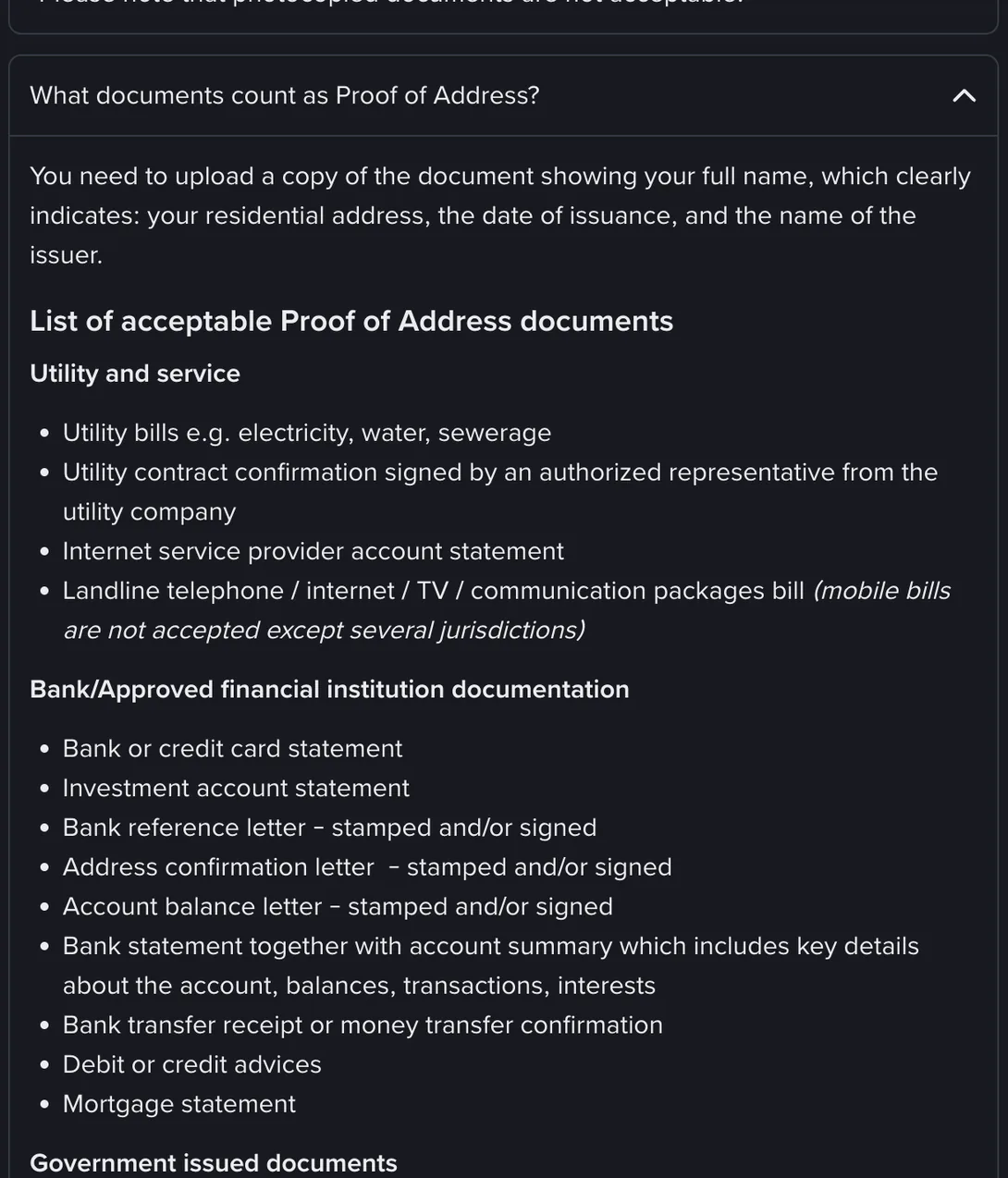
Read the groups rather than the individual lines. The first is utilities and services: electricity, water, sewerage, internet, landline, television packages. The page marks mobile bills as not accepted except in several jurisdictions, which stings, because a mobile bill is the only bill in their own name that millions of people have ever had. The second group is banks and approved financial institutions: statements, reference letters, address confirmation letters, balance letters, transfer receipts. The third is government issued documents.
Those groups matter here because the second one is the one you can influence. You cannot ask the state electricity board to reprint your bill in English. You can very often ask a bank.
Which document in the drawer is already in English
Before ordering anything new, go through what exists. In countries where English is an official or widely used language, bank statements are often issued in English, so the one you pull from net banking may already be in English without anyone having to request it. Check what your own bank actually produces. If it is in English, the problem is solved and it costs nothing.
| Where to look | What you are checking |
|---|---|
| Net banking, statements section | That the PDF prints your name and your full residential address, not just a name and an account number. A statement without an address is not a proof of address |
| Credit card statement | Often the most reliably addressed document a bank produces, and usually in English |
| A bilingual utility bill | Many utilities in South Asia and the Gulf print the header in English underneath the local script. If the four items appear in the English half, you are done |
| Broadband or landline bill | Frequently issued in English even where electricity is not, since the operator bills nationally |
| A tenancy agreement in Arabic | Sometimes issued bilingually, and in some jurisdictions registered with a housing authority. The page lists government issued documents as its own group, so check the registration copy rather than the private one |
The document that usually fails is the one people reach for first. The electricity bill is in the local script and, in a rented flat, in somebody else’s name, so it is useless on two separate counts at the same time. The statement takes a few minutes to download and prints a name and a full address at the top of page one.
If the name on the document is the problem rather than the language, that is a different page and a longer job.
What people do to a local-script bill, and what it costs them
Here is where this goes wrong. Faced with a document in the wrong script, people improve it, and most of the improvements move the file from hard to read into altered, which is a much worse place to be.
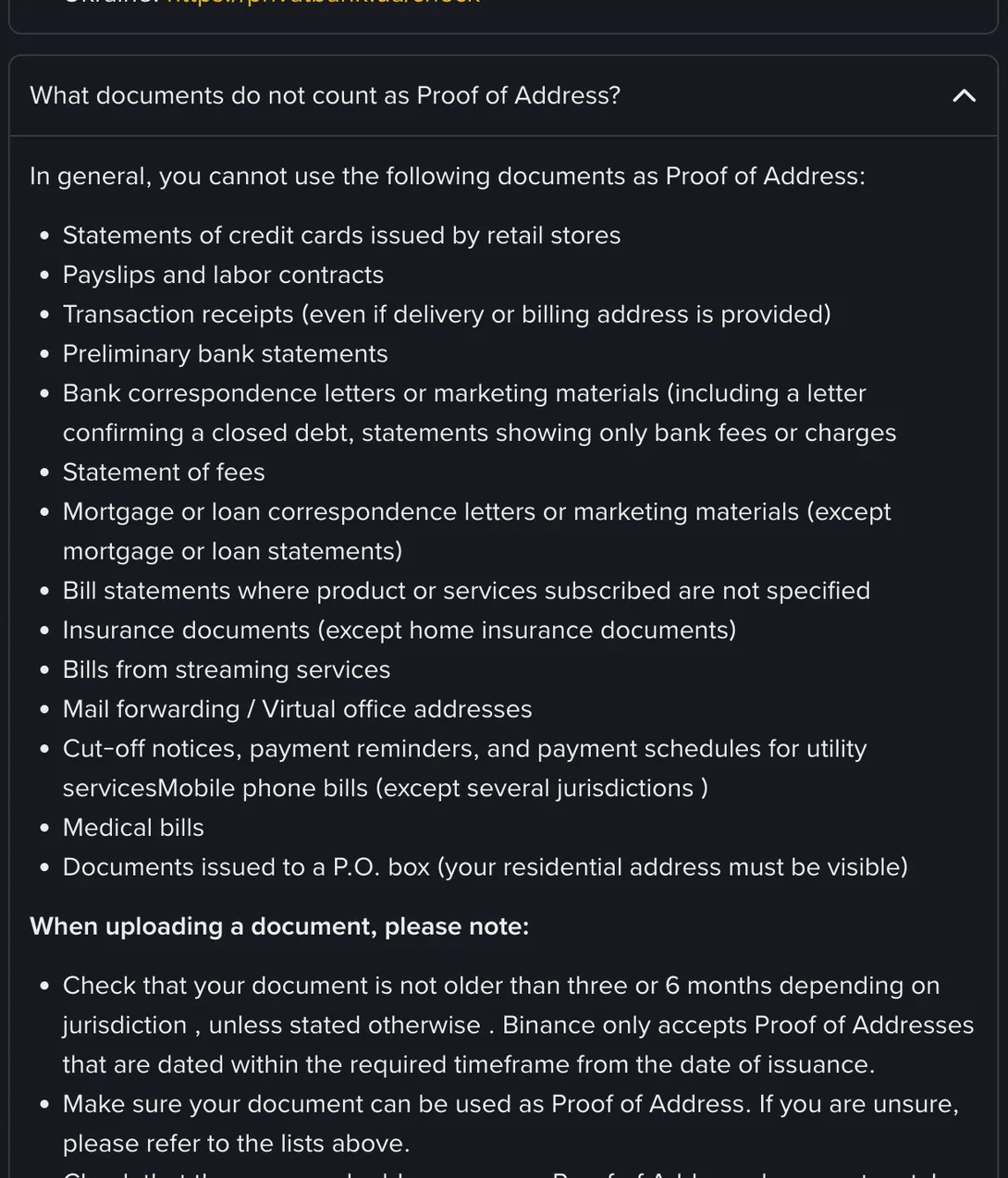
Two of the notes in that block are visible on the screenshot above. The first tells you to check that your document is not older than three or 6 months depending on jurisdiction, unless stated otherwise. The second tells you to make sure your document can be used as a proof of address at all, which is a polite way of pointing back at the list above it. Further down the same block sits the note this whole section turns on:
Please use original, unedited documents only and avoid documents with cuts.
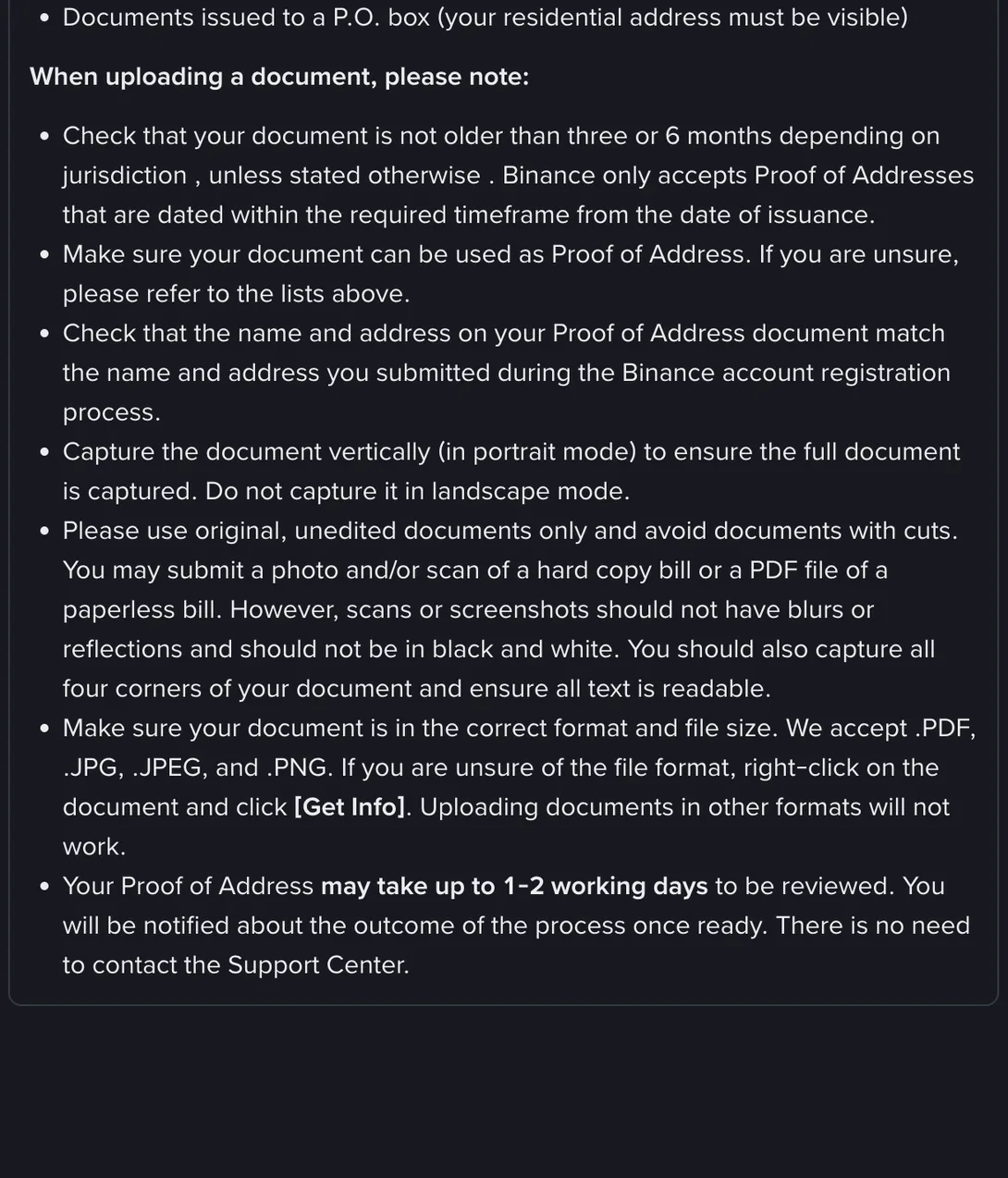
With that sentence in view, here is the same set of well-meant actions, sorted:
| What you were about to do | Where it lands |
|---|---|
| Type out an English translation and upload it instead | You are now the issuer. There is no issuer name on it but yours |
| Merge the bill and your translation into one PDF | Two documents in one file. One proof of address means one document |
| Crop the page down to the name and address block | The note names this one outright: avoid documents with cuts. It also removes the issuer details that the four-item requirement asks for |
| Black out the account number for privacy | An edit. Whatever is checking the file sees that it was modified, not which box you covered |
| Screenshot the statement inside the banking app | A screenshot is an image of a screen, not a document, and it usually shows no issue date and no issuer |
| Print the PDF, then photograph the printout | Two generations of loss for no gain. Send the PDF |
| Use the browser’s print-to-PDF on a statement page | The file is then produced by your browser rather than the bank’s system. Download the bank’s own PDF instead |
| Rename the file to poa.pdf | Fine. The name is not part of the document |
| Export a full page of the PDF as an image, nothing cropped | Usually fine where the upload only takes images. Whole page, no trimming |
The pattern behind the bad rows is one thing: the file changed while it was in your hands, and the change leaves a trace, in the text layer, in the file’s own properties, or in the pixels. None of that is about honesty. A person blacking out an account number is being careful, and the check does not have a category for careful.
Your name in Latin letters, spelled the same twice
Get an English document and a second problem walks in behind it. Your name has never had one fixed spelling in Latin script.
The passport office chose one transliteration. The bank chose another when you opened the account, possibly in a different decade, possibly with a middle name dropped or an initial expanded. Muhammad, Mohammad, Mohammed. Krishnan, Krishnaan. Wanjiru with or without a Christian first name in front of it. Each of those is a different string to a machine comparing two fields.
The rule is short: type into the form exactly what is printed on the identity document you are uploading, and make the address document agree with it. If the bank has a shorter version of your name on file, changing the bank record is the fix, and it takes one visit. Changing the form to match the bank instead will break the comparison against your ID at the confirmation screen, and some of those fields do not come back once confirmed, which is its own subject entirely.
Address transliteration has the same problem in miniature. Road, Rd, Marg, Sarani, Barabankwa: the bank recorded one of them and you may type another. Copy the address from the document you are about to upload, word for word, rather than writing out the address you would give a taxi driver.
Does the checker read Devanagari?
Honest answer: I could not confirm this on Binance’s pages, reading them in September 2026. Nothing is published about which scripts the document reading step handles, and a guess would be worse than useless here, since it decides whether you spend an afternoon at a bank counter.
What can be said is structural. Two separate things happen to an uploaded file: something extracts fields from it, and somebody reviews the case. A document in Devanagari, Urdu, Arabic, Sinhala or Amharic may well be handled by either, both, or neither, and you have no way to find out which before you submit. A document in English removes the question. That is the argument for the bank statement, and it is the only argument this page will make about scripts.
What Binance does publish about the document reading step is that your ID is scanned for data extraction, which appears on the identity verification page rather than on this one. Address documents may be treated differently again, and that difference is not documented anywhere public.
There is one line about local-script documents on that other page, and it answers a question that is easy to ask in the wrong order. In the second FAQ item on the identity verification help page, the one headed How to update/reset my identity verification information, Binance lists the reasons an update is accepted. Number six on that list is: “Change the name to a system-recognizable language (e.g., from local-language ID card to English-language passport).”
So verifying now with the local-language card you actually hold does not commit you to it for good. Moving later to an English-language passport is a route the platform names itself, which makes the sensible order clear enough: verify with what is in the drawer today, and change document when you have a reason to, not before.
The last move: ask the bank in writing
If the downloaded statement prints no address, or your bank’s system genuinely produces the statement in the local script, this is the request to make. It is one sentence long and it is best made in writing, at the counter or through the bank’s secure message facility, because a spoken version gets translated into whatever the person on the other end thinks you meant.
Ask for an account statement in English, addressed to your current residential address, showing the issue date and the bank’s name, and ask for it as a PDF. Four things in one sentence. If they can only give you paper, ask them to stamp it, then scan the whole page rather than photographing it.
Two details worth settling in the same conversation. Check which address the bank holds for you, since the statement prints the one in the system rather than the one you live at; if it is a former address, change that first and wait for the next cycle, because a statement carrying an old address creates a new mismatch rather than fixing the old one. And check how your name is spelled in their records while you have someone’s attention, since that is the field you will be comparing against your ID an hour later.
Then download it, open it, and try to select your own name with the cursor. If the characters highlight, the file has a text layer and the four items are there to be read. That is the point at which the local-script bill goes back in the drawer, where it belongs.