Can I use my father’s electricity bill to verify my account? On its own, no. The document has to carry your name, and the reason is narrower than it sounds: the check is reading the header, not the address. So the job is not to argue for the bill you have, it is to get one thing issued in your own name at the address you actually live at, and if you already bank locally, that can be a statement you download tonight. One line before the how: sorting out an address document does nothing for the money side. What you put into crypto can be lost in its entirety, and a tidy proof of address has never altered that.
Why a covering letter does not rescue somebody else’s bill
Search this problem and the first answer you find will be: use your flatmate’s bill and attach a signed letter explaining the arrangement. That advice comes from opening a bank account in person, where a human being reads the letter and asks you a question. Nothing like that happens here. The first pass over your file is automated, it is looking for your full name on the document, and a letter it was not asked for does not get opened.
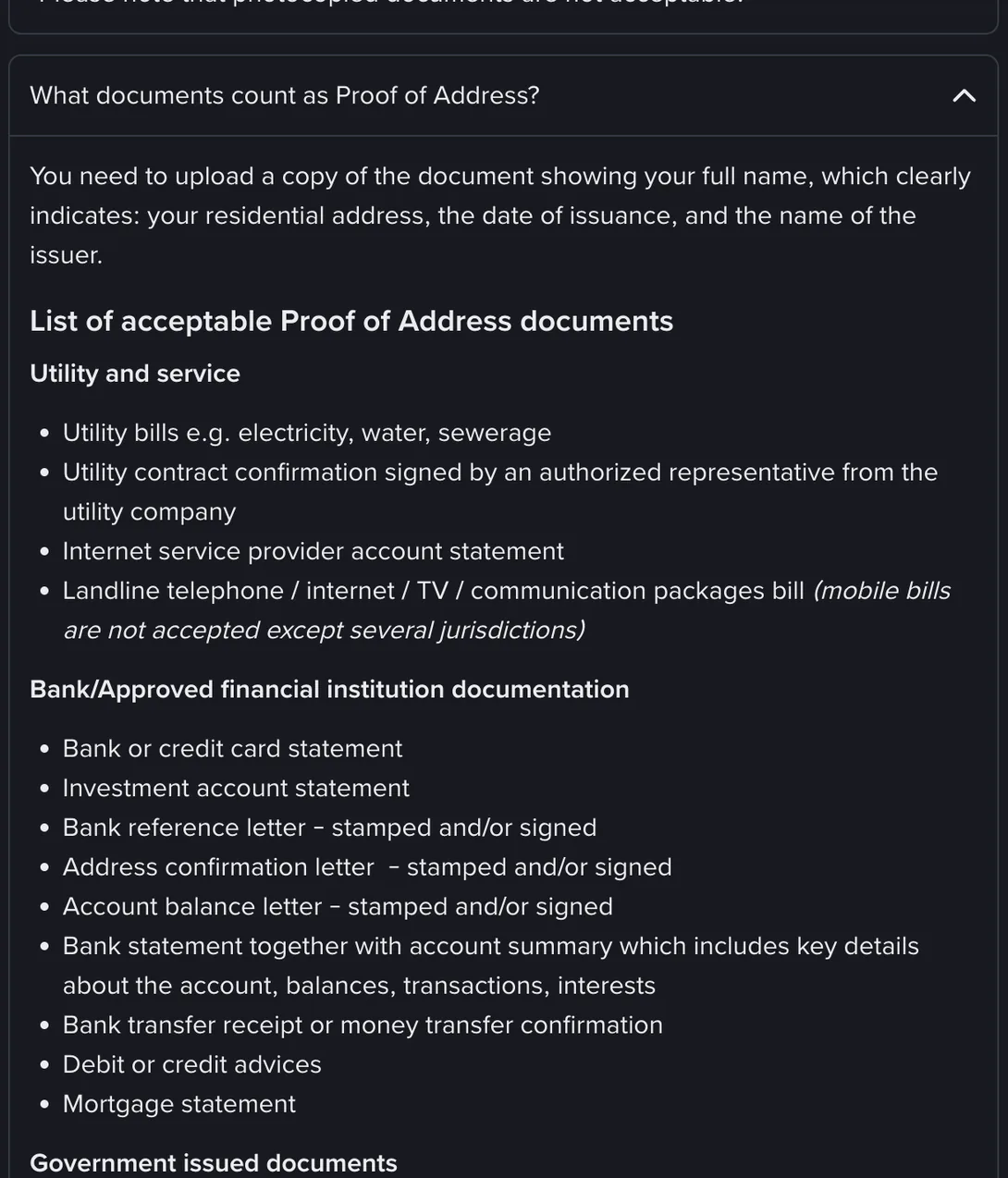
Binance sets out what one document has to carry, on the residential address page, in the second question:
You need to upload a copy of the document showing your full name, which clearly indicates: your residential address, the date of issuance, and the name of the issuer.
Four things, one piece of paper. Your flatmate’s bill has the address, the date and the issuer, and is missing your name. The letter has your name and is missing an issuer, because your flatmate is not an issuing institution. Together they contain all four, and together is not an option.
A useful rule: if a document needs a covering letter to make sense, treat it as a document you do not have. An evening spent drafting that letter is an evening not spent getting a real one issued.
Sharing a flat
Say it looks like this: four people, one tenancy, the broadband set up by whoever arrived first, electricity still in the landlord’s name, and you paying your share by transfer every month with your name appearing on nothing.
Three routes, quickest first.
Change the address on a bank account you already have. Nothing new gets opened, so nothing has to be approved. Update the address in the app or at the branch, and the next statement prints with it. While you are in there, check that the account is in your legal name as printed on your ID rather than a short form or a nickname, because a statement that says Raj instead of Rajendra will come back for a different reason entirely.
Move the broadband account into your name. Talk to the flatmate whose name is on it and ask the provider to transfer the account. The first bill after that is yours. The cost of this is real: the debt on that line becomes yours too, and you will be the one chasing everyone else for their share.
Add yourself as a joint account holder. Some providers will print two names on the statement. Whether a two-name statement is treated as being in your name is not addressed on Binance’s public pages, so before you rely on it, ask the provider for a sample of the next bill and look at the header. If your full name is not printed there, this route is finished.
Not the mobile bill, which is the first thing nearly everyone reaches for. Binance’s list covers landline, internet, TV and communication package bills, then adds in brackets that mobile bills are not accepted except in several jurisdictions. Same operator, same monthly PDF, different category.
Living in your parents’ house
Across India and Pakistan this is the default situation for adults in their twenties and thirties, and it is not a problem to be explained away. The house is your father’s, the electricity account has been in his name since before you could read, and it should stay there.
So do not try to move anything of theirs into your name. Move the address onto something that is already yours. If you have a bank account or a credit card, check the address registered against it; it may still be a college hostel or a previous house. Change it, wait for the statement cycle, download the PDF from net banking rather than photographing the posted copy.
The other thing worth checking in the same session is whether your bank will issue an address confirmation letter. The accepted list names one: an address confirmation letter, stamped and/or signed, sits in the same group as bank statements. In India, Pakistan and South Africa this is an ordinary counter request, and it does not require you to wait for a billing cycle at all.
A family relationship document, a ration card, a birth certificate showing you are the account holder’s child, does not solve it. That is the same two-documents-and-an-inference structure as the flatmate’s letter.
Hostel and university accommodation
In hall, everything is bundled into the accommodation fee, so no monthly bill exists in anybody’s name. What you have instead is the university, which will issue you a letter, and a bank, which will not until you give it an address.
The letter is worth more than students expect. Further down the accepted list, in the group after the government one, two entries are written for exactly this situation: “Student rental agreement from university residence or university housing/halls” and “Letter from a university to confirm student attends and their current residential address”. So the enrolment or allocation letter is a document in its own right here, not just something to take to a bank. Take it to the bank anyway while you have it, because a statement solves the same problem again next year without another trip to the registry.
Hostel addresses have a specific trap: they are incomplete. What the university gives you is Room 312, Hostel C. A usable address has four layers, which are the building, the room, the street with its number, and the postcode. Put all four into the bank’s records. A statement showing only a university name and a city has no house number on it, and the list of documents that do not count is explicit that your residential address has to be visible.
If a government body writes to you at that address, a tax notice, a residence registration, an electoral document, keep it as well. Government issued documents are their own group on the accepted list, sitting above the group that holds the two student entries, and a government issued grant, loan or bursary letter addressed to where you are living now is named in that lower group as well.
Accommodation provided by your employer
Millions of people from India, Pakistan, Kenya and the Philippines live in accommodation their employer arranged: staff housing in the Gulf, a compound near a mine site, quarters attached to a hospital or a hotel. The address on your residence card or your employer letter is the camp or the block, not a flat you rent, and no utility account will ever exist in your name there.
This one is genuinely harder, and there are two honest answers rather than one.
The first is the bank again, and it is the one that works most often. The salary account your employer opened for you already has an address on file, and that address is probably the accommodation. A statement from it, or a stamped address confirmation letter, is a document from an approved financial institution carrying your full name. If the address on file is the company’s head office rather than where you sleep, ask for it to be corrected before you request anything.
The second is the employer letter itself, and this site will not tell you it counts, because that is not verifiable from any public page. It is not named on the accepted list. What it reliably does is get you the bank record above.
The set of rules you are under follows the address you sleep at, not the passport you hold. The validity table below has separate rows for Binance BH/GCC and for Binance FZE in Dubai, which is what that splitting looks like in practice: residents of the UAE deal with Binance’s local entity and its own requirements. If that is you, the requirements to work from are that entity’s, not the ones in a guide written for the country you came from.
You moved in last week and nothing has arrived yet
You are not short of documents, you are short of time. The broadband is ordered, the bank address is updated, the tenancy is signed, and every one of those things produces its first paperwork in three weeks.
Start with the tenancy, because it might already be usable. Scroll the accepted list down to the group headed Government issued documents and the second entry in it is this one:
Government tenancy contract or tenancy contract information registration certificate (Document should be issued by the state body or confirmed by housing authority and is valid within 1 year)
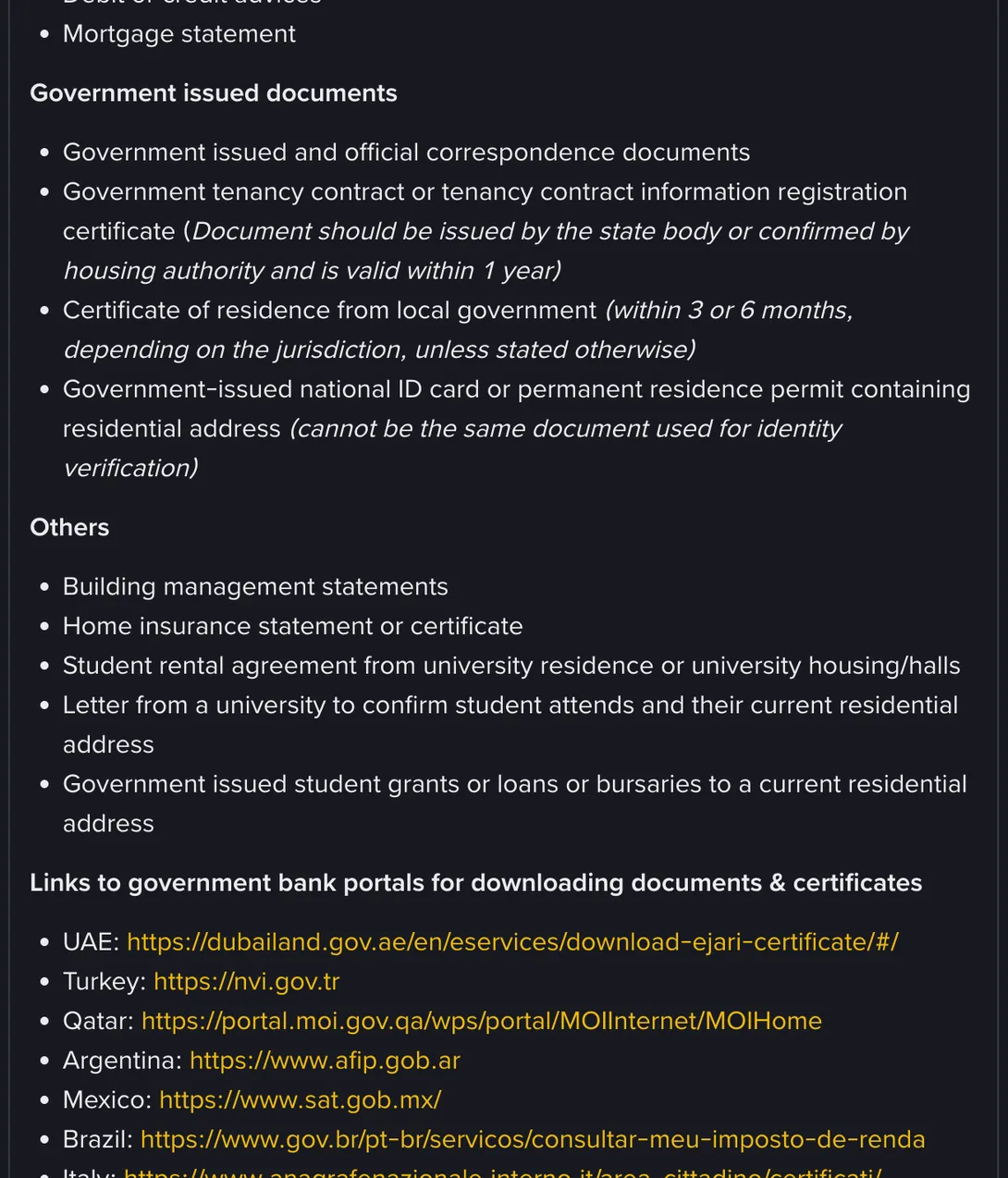
Read the bracket rather than the headline. A year of validity is generous compared with a bill, but the document has to have been issued by a state body or confirmed by a housing authority, which is the half people skip. Whether yours qualifies therefore depends on whether your country registers tenancies at all. Where registration exists, the receipt is a document you can hold the same week you move in. Where it does not, a private agreement between you and a landlord is two signatures on a page.
Then look up the billing dates rather than refreshing your inbox. Every service has a fixed statement date, set by its own billing cycle rather than by the day you signed up. Your bank app shows the next statement date; the broadband portal shows the next bill date. Find out which one lands first, and stop watching the other.
One thing to skip: the counter-printed interim statement some banks will hand you on the spot. The third question on that page, the one listing what does not count, names preliminary bank statements.
Which document, which country, how new
Getting your name on a document is half the job. The other half is that it has to be recent, and how recent is not the same everywhere. The table is folded into the first question on the same help page, under What is a Proof of Address, and the definition above it says the document must be issued in your name and match the name of the Binance account owner.
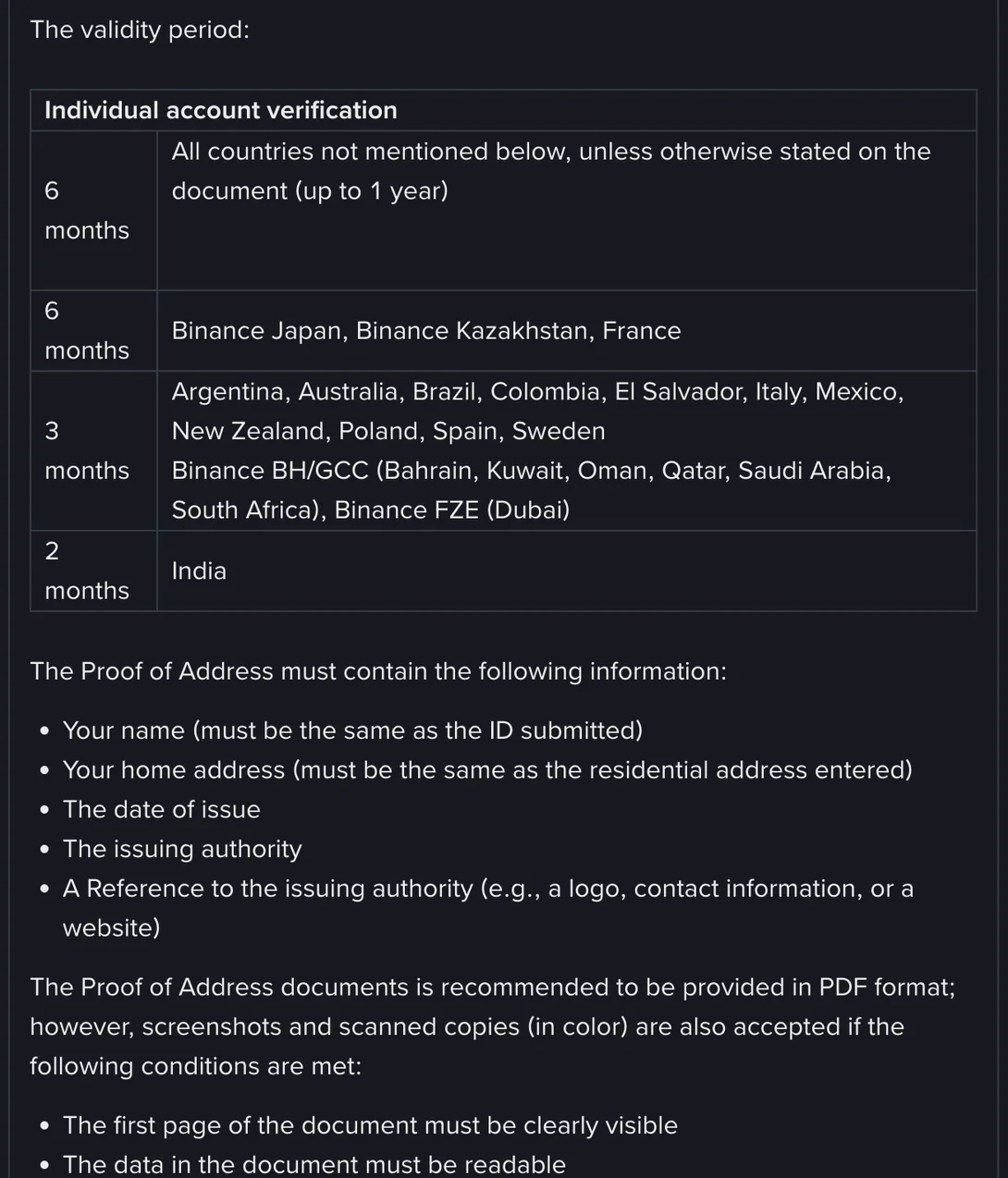
Reading it in September 2026: six months is the default for all countries not named, unless the document itself states otherwise, up to a year. Three months applies to a list that includes Australia, and to the Binance BH/GCC row, which is where South Africa appears alongside Bahrain, Kuwait, Oman, Qatar and Saudi Arabia. India gets two months. Pakistan, Kenya, Ghana and Sri Lanka are not named, so they fall under the six-month default.
Two months is short enough to change your plan. If you are in India, do not start this process with a statement you downloaded in the spring, and do not request the bank letter until you are ready to use it. Elsewhere the pressure is lower, but the clock always starts on the day the issuer dated the document, not on the day it reached you.
One caveat, and on a page built out of country rows it is not boilerplate: that table is maintained by Binance and it gets edited, so the row that decides your case is the one live on the day you upload rather than the one read here in September 2026. Which makes this a reading, not advice, legal or financial.
The whole thing in one table
Fastest means the route that usually produces a document first, not the only route. The waiting column is measured in the issuer’s billing cycles, because that is who decides it.
| Situation | Fastest thing in your own name | Roughly how long |
|---|---|---|
| Shared flat, bills in a flatmate’s name | Change the address on an existing bank account; otherwise transfer the broadband account | One statement cycle |
| Living with parents | Bank or credit card statement after an address update, or a stamped address confirmation letter from the bank | One cycle, or same week for the letter |
| Hostel or university accommodation | University letter used to open or update a bank account, then the statement | One cycle after the account is updated |
| Employer-provided accommodation | Salary account statement or bank address confirmation letter, once the address on file is corrected | Same week to one cycle |
| Just moved, nothing issued yet | Tenancy registration receipt where your country registers tenancies; otherwise whichever billing date falls first | Same day, or under one cycle |