Home/Quick checks/KYC document checklist
KYC document checklist
Four questions, and the desk builds the list for your case: what to gather, which fields are set for good once you submit, and the joins where things most often fail to match. Copy the whole thing to your notes when you are done.
What comes out is common practice, not Binance policy. What you are actually asked for shifts with your country and the state of your account, so the verification page inside your account is the one that counts. The four answers are worked out in your browser and are neither uploaded nor stored.
INPUT · FOUR ANSWERS
Pick whichever you hold that runs longest and reads most clearly. You can still change it before you submit.
Where you actually live and can obtain a bill, not where your document was issued. The two are separate fields on the form.
What matters is that your full name and your full address appear on the same page. One without the other is not enough.
Go by the name field on the document itself. If it carries both scripts, as many passports do, count it as the Latin line.
Each one settles a different part of the list, and the list is incomplete without it. Asking more would add nothing:
Document type decides how many photographs you take and of which sides. Country decides which address documents are usable and how recent yours must be. The bill decides whether you can submit today or have to request something first. The script your name is in decides which field is likeliest to go in wrong — and the name is one of the few that cannot be edited afterwards.
Your age, your job and what you intend to trade have no bearing on which documents you need, so they are not asked and nothing about you is stored.
LIST · WHAT TO GATHER
5items to gatherBuilt from the four answers on the left. Change any of them and the list follows.
A · ITEM BY ITEM
- If the script never runs, scroll down: every branch of this list is written out in full on the page.
B · FIELDS THAT LOCK ON SUBMISSION
C · WHERE THINGS FAIL TO MATCH
- Answer the four on the left and this lists the joins that most often come apart in your particular case.
This is a self-check built from common practice, not the platform’s review standard. Your four answers have not left this device. What you must submit, and whether it passes, is set by the verification page inside your account and by the review itself.
Every branch, written out
These tables lay out each branch of the desk above without needing a script. If the tool refuses to start, or you simply want to see somebody else’s case, read them straight. They are wide; on a phone you can scroll them sideways.
By document type
| Document | How many photographs | Watch for |
|---|---|---|
| National ID card | 2: front and back | Sending only one side gets the file sent back. Both need four corners in frame and readable print. |
| Passport | 1: the whole data page | The two machine-readable lines along the bottom have to be in frame — that is where the details are read from. |
| Driving licence | 2: front and back | Binance lists it as a document type, but whether a particular country’s licence is accepted varies. Turned down on that ground, switch document rather than resubmit. |
By country, for the address document
| Country | How recent it must be | Where it usually goes wrong |
|---|---|---|
| India | 2 months — the shortest row on the official table | The address on an Aadhaar is often the one you grew up at. Enter the address you can produce a document for, and keep the two consistent. |
| Pakistan | 6 months, the default for countries the table doesn’t name | Utility bills tend to sit in the head of the household’s name. A mobile bill is not accepted in most places. |
| Australia | 3 months — Australia is named in that row | A driving licence carries an address, but whether it doubles as an address document depends on the current page. Have a statement ready as well. |
| South Africa | 3 months — grouped into the same row as Binance BH/GCC | The Smart ID card carries no residential address at all, so a separate document is always needed. A municipal statement is the usual answer. |
| Kenya | 6 months, the unnamed-country default | The national ID carries no address either, and rented places often bill the landlord. Sort the name on the account before you need the document. |
| Somewhere else | 6 months unless the document itself states otherwise | When your document was issued somewhere other than where you live, both fields have to be filled honestly. Making them the same to save trouble causes more of it. |
By the bill you have
| Your situation | Next step |
|---|---|
| Yes, I have one already | Check the issue date against the window for your country. An out-of-date document comes back. |
| No, I need to get one | Download an electronic statement from your banking app or the utility’s own site; a PDF usually exports on the spot. Don’t use a cropped screenshot of the name alone. |
| Not sure whether mine counts | Open it and confirm two things: your full name, and your full address. One missing means it does not count. |
By the script your name is printed in
| The document shows | What else to have | Easiest thing to get wrong |
|---|---|---|
| A non-Latin script | A reference for the Latin transliteration — the passport page, or the bank card you already hold | Type the transliteration exactly as the document prints it, letter for letter. The version you normally use, or a slightly different spelling on another card, is what causes the mismatch. |
| The Latin alphabet | Nothing extra; copy the document | First name and last name go in the wrong boxes more than anything else. With a middle name, a compound surname or a single name and no surname, split it the way the document splits it. |
Fixed for good, whatever you answered
Legal name, date of birth, document number, document issuing country or region, country or region of residence. Once confirmed, changing any of these means a manual case with its own documents and its own wait. Reading them aloud against the document before you press continue costs a minute.
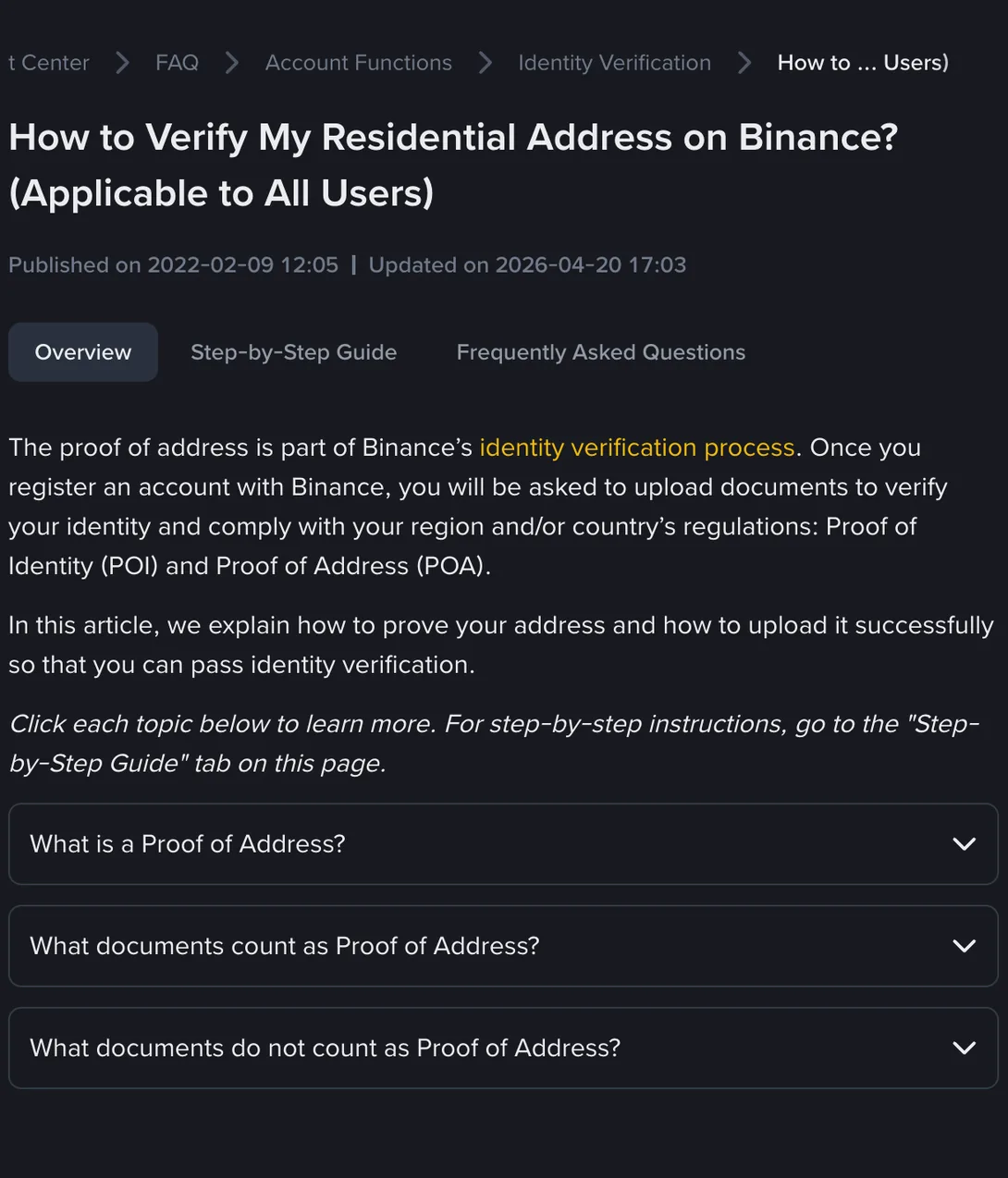
The proof of address is part of Binance’s identity verification process. Once you register an account with Binance, you will be asked to upload documents to verify your identity and comply with your region and/or country’s regulations: Proof of Identity (POI) and Proof of Address (POA). That is why an address document is on the list by default rather than as an option. The three headings below it are collapsed on the live page, and what they contain varies by country. Screenshot taken 2026-09.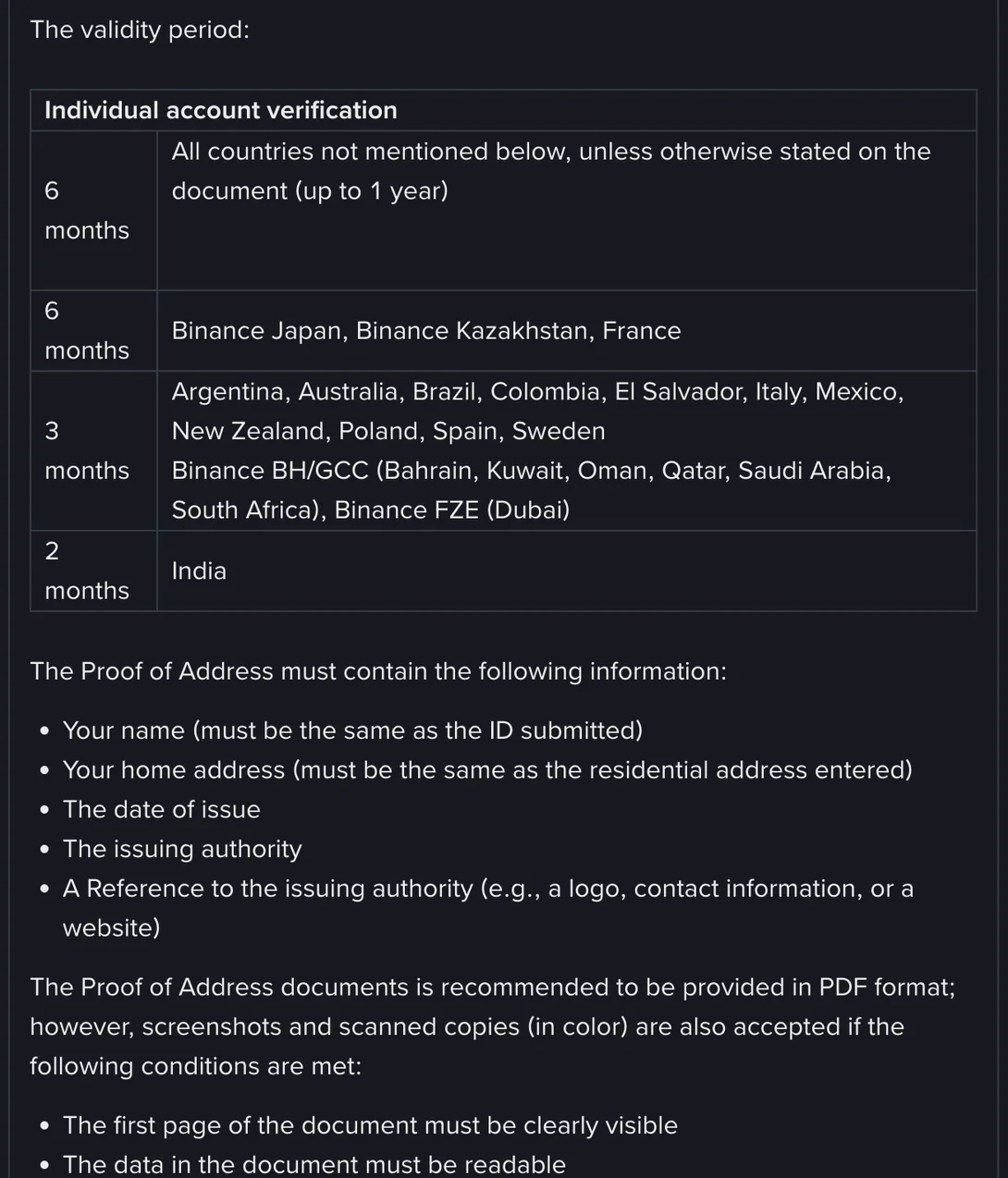
6 months for all countries not listed below unless the document says otherwise, 3 months for a named group including Australia and, under Binance BH/GCC, South Africa, and 2 months for India. Pakistan and Kenya are not named, so they take the six-month default. Screenshot taken 2026-09.Open: how to use this list, and where each line comes from
The problem it addresses
What stops people is rarely not knowing how to fill a form. It is starting the form before the documents exist. Halfway in you are asked for an address document, you go digging through email for a statement, and the page has timed out by the time you return. Or you upload the document and then remember the transliteration of your name went in the wrong way round — and the name is one of the fields you cannot revisit. This desk gets everything onto the table before the verification page is open.
Using it
Set the four selects on the left to your actual case; the list on the right redraws as you go, and there is nothing to submit. It comes in three blocks: A is the items themselves, B is the fields that lock, C is where things fail to match in your particular combination. Press Copy this checklist to take the plain text into your notes and tick it off.
Where each line comes from
The shape of it is documented. Binance’s help centre article on verifying your residential address states that proof of address is part of identity verification, and that after registering you will be asked for Proof of Identity (POI) and Proof of Address (POA). So an address document is on the list by default rather than as an option.
The validity windows are documented too, and they differ by country: the table on that page gives six months as the default for countries it doesn’t name, three months for a group that includes Australia and — inside the Binance BH/GCC row — South Africa, and two months for India. Pakistan and Kenya are not named, which puts them on the six-month default. Both screenshots are above so you can read the rows yourself, and the address sheet goes through them properly.
How many sides of a card to photograph, and which documents your particular country will accept, are common practice rather than a published rule: Binance publishes no single answer that holds for everyone, and the acceptable-document lists are regional. So the wording throughout says common practice, never Binance policy. What you must actually submit shifts with your country and your account, and the verification page inside your account is the one that counts.
Block C comes from a plain observation: things go wrong at the joins between two documents — the name on the card against the name in the form, the address on the bill against the address on the card, which half of your name is the surname. All the desk does is point at the joins your combination creates.
Data and privacy
The four values are used for a calculation on your device. They stay inside the tool and are not uploaded to or analysed by us. The page separately uses Google Analytics 4 (GA4) for visit statistics, as explained in the privacy policy. The tool does not save the values or keep a history; refresh the page to return it to defaults. The copy button uses the browser’s own clipboard, and what it copies goes only to your clipboard.
What it cannot do for you
It does not know your country’s current requirement, which level your account sits at, or whether anything has been flagged on it. It does not know whether the file you upload will come back for sharpness. It produces a list to gather, not a prediction of the outcome. The real list is the one you see after logging in, and where that disagrees with this, that one wins.
Who it suits
Anyone who hasn’t started and would rather gather everything once, and anyone sent back a single time who wants to work out which item was missing. If you are already inside the verification flow and stuck on a specific error, the matching sheet will be quicker.
Read alongside
The address document has the most detail in it and a sheet of its own: what counts as proof of address. If the bill is in someone else’s name, this one. Still deciding between documents, passport, ID card or driving licence. Worried about the name and birth date fields, the fields you can’t change yourself. Already sent back, 12 reasons and fixes. And to test the photograph itself, the ID photo pre-flight check.