Everything Binance publishes about address documents lives on one help page, and that page is mostly closed. Three questions, folded shut, and the one people click is the middle one, because that is the one that looks like a list of documents. The definition and the deadline are inside the first question, which almost nobody opens.
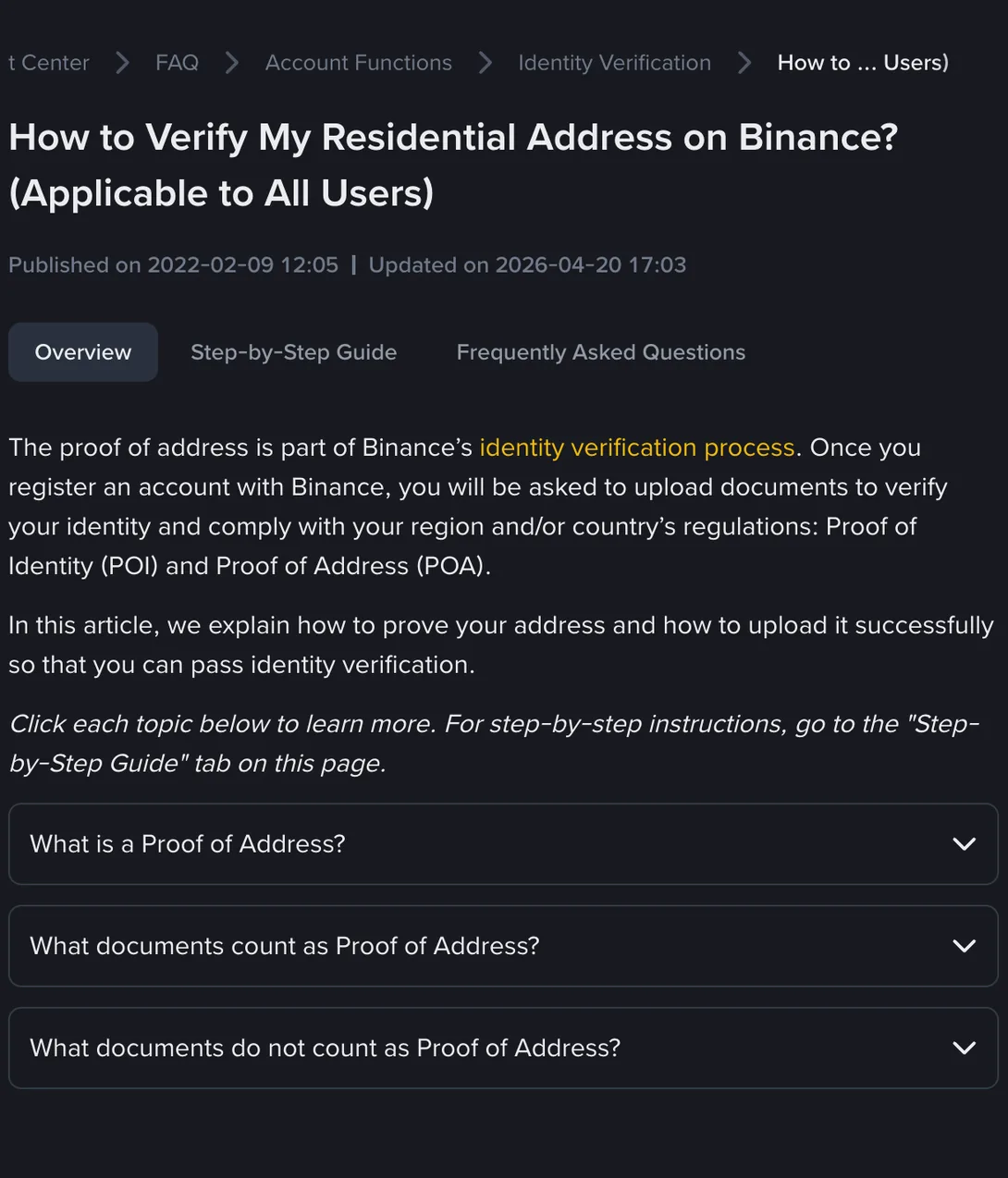
One page, three folded questions
The title is How to Verify My Residential Address on Binance? (Applicable to All Users), and the three tabs across the top are Overview, Step-by-Step Guide and Frequently Asked Questions. Underneath, the introduction sets out what the whole thing is for:
The proof of address is part of Binance’s identity verification process. Once you register an account with Binance, you will be asked to upload documents to verify your identity and comply with your region and/or country’s regulations: Proof of Identity (POI) and Proof of Address (POA).
Two documents, two questions. POI answers who you are. POA answers where you live. People who think their card settles both are usually thinking of the address printed on it, which was accurate on the day it was issued and says nothing about this year.
The phrase to notice in that paragraph is your region and/or country’s regulations. It is doing more work than it looks like. If a friend was not asked for this and you were, that clause is the first place to look for the reason.
Below the introduction sit the three folded headings: What is a Proof of Address? · What documents count as Proof of Address? · What documents do not count as Proof of Address?
The list in the middle question is genuinely useful and genuinely long. It is organised into three families: utility and service accounts, documents from a bank or an approved financial institution, and government issued documents. This page is not going to reprint it, because it varies by country and it gets edited, and a copy of a list is worth less than the list. Open the second question on the residential address page and read the version your screen shows you.
What follows here is the rest of the page. The parts that decide whether a document from that list still gets refused.
When are you actually asked for address proof?
Binance does not say. I looked for a published trigger rule on its pages in September 2026 and could not confirm one: the residential address page explains what a POA is and what qualifies, the step-by-step tab explains how to upload it, and nowhere does either say which accounts get asked, at what point, or on what basis. Anyone who tells you the exact threshold is guessing, and the guess is usually copied from a forum post with no date on it.
What the page does say is the sentence quoted above: it is part of identity verification, and it is tied to the regulations where you are. That is enough to plan around, in one direction only. Treat the request as something that can arrive at any point rather than as step four of five.
The reason to care before it happens is the clock, and this is the whole practical argument of this section. Your identity document already exists, in a drawer. An address document does not exist until an issuer issues it. A bank statement appears on the bank’s statement date. A bill appears on the billing date. If you are asked today and your last statement is five months old and you live in India, there is no version of the next hour that fixes it, and there is no version of the next week either.
So the cheap move is to know, right now, which document you would use and when its next edition lands. That is a five-minute job in a banking app. The checklist builder on this site does the same thing from the other end, by country and living situation.
Worth keeping the size of the errand in proportion while you chase paper: prices on the other side of the account move without warning and in either direction, and you can lose everything you put in. Getting an address document accepted has never had any bearing on that.
Issued in your name, and matching the account
Open the first question and the definition starts with a condition that carries most of the failures:
It must be issued in your name and match the name of the Binance account owner.
Read as two separate tests, because they fail separately.
Issued in your name. An institution printed your name on it. Not you, not a relative, not a landlord writing a letter. This is what rules out the household electricity bill in a father’s name, the flatmate’s broadband, and the covering letter people attach to explain either of those. If your situation is that one, the routes out of it are their own subject: what to do when the document is not in your name.
Match the name of the account owner. The name on the document has to be the same string as the name on the account, which came off your identity document. This is the half that surprises people who have the right document. Banks abbreviate. A statement headed R. Kumar against an account registered as Rajendra Kumar is a mismatch a machine has no way to resolve, and neither has the reviewer it gets escalated to. Same problem, differently shaped, when a name was transliterated one way at the bank and another way on the passport, which is common enough across Urdu, Hindi and Arabic scripts to deserve a page of its own.
Fix the name at the issuer, then wait for the next document. Fixing it at the issuer is slow and boring and it is the only route that leaves you with a clean file.
How old is too old, country by country
Still inside the first question, under the definition, is a table headed The validity period. This is the part worth the click.
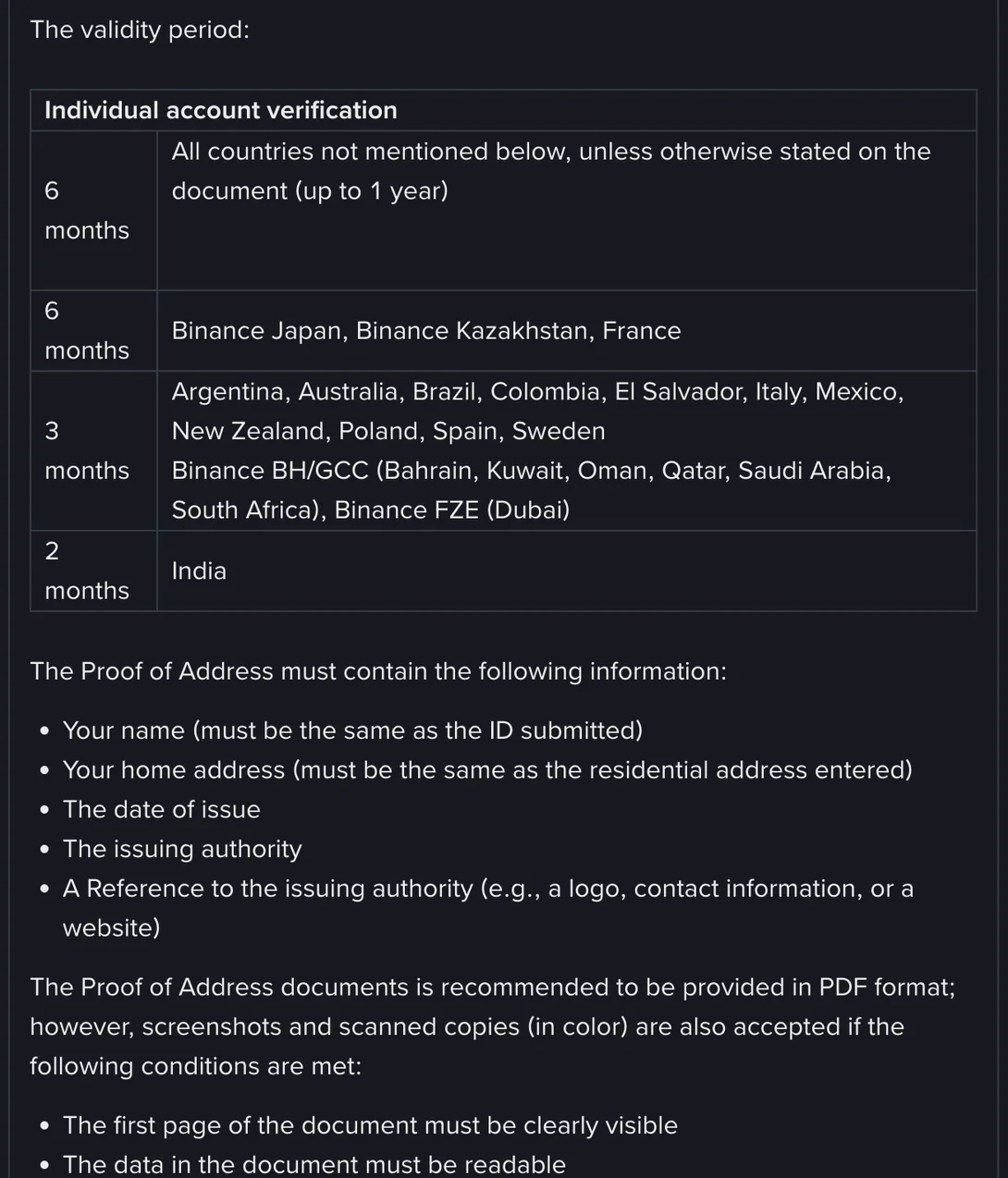
Reading it in September 2026, for the countries this site is written for:
| Where you live | Document must be no older than | Which row |
|---|---|---|
| India | 2 months | Its own row, the last one |
| Australia | 3 months | Named in the three-month list alongside New Zealand and several European countries that Binance no longer signs up; a row here is a document rule, not a sign-up promise |
| South Africa | 3 months | Inside the Binance BH/GCC line, with Bahrain, Kuwait, Oman, Qatar and Saudi Arabia |
| Pakistan | 6 months | Not named, so the default row |
| Kenya | 6 months | Not named, so the default row |
The default row reads: six months for all countries not mentioned below, unless otherwise stated on the document, up to a year. That last clause is a real allowance. Some documents carry their own validity on their face, a registered tenancy certificate being the usual example, and where they do, the document wins.
South Africa being inside the Gulf row is the detail people miss, because there is no reason to look for it there. Two things follow from that placement, and only one of them is about dates: it also means the row is describing which Binance entity you deal with, not just how many months you get.
India at two months changes behaviour rather than just timing. Two months is shorter than most billing relationships feel. It means requesting the bank letter after you are ready to upload rather than before, and it means a statement you saved for this purpose in July is already scrap in October.
Two months, three months, six: the window your document has to fit inside is written by the jurisdiction your account sits under, and Binance edits the table as those change. So take nothing here as legal or investment advice, and open the live table before you download the statement rather than after.
Three lines that send back a document that was real
Most refusals in this step are not forgeries. They are honest documents in the wrong category, or a month too old. Three entries account for a large share of that, and all three are on the list under the third question.
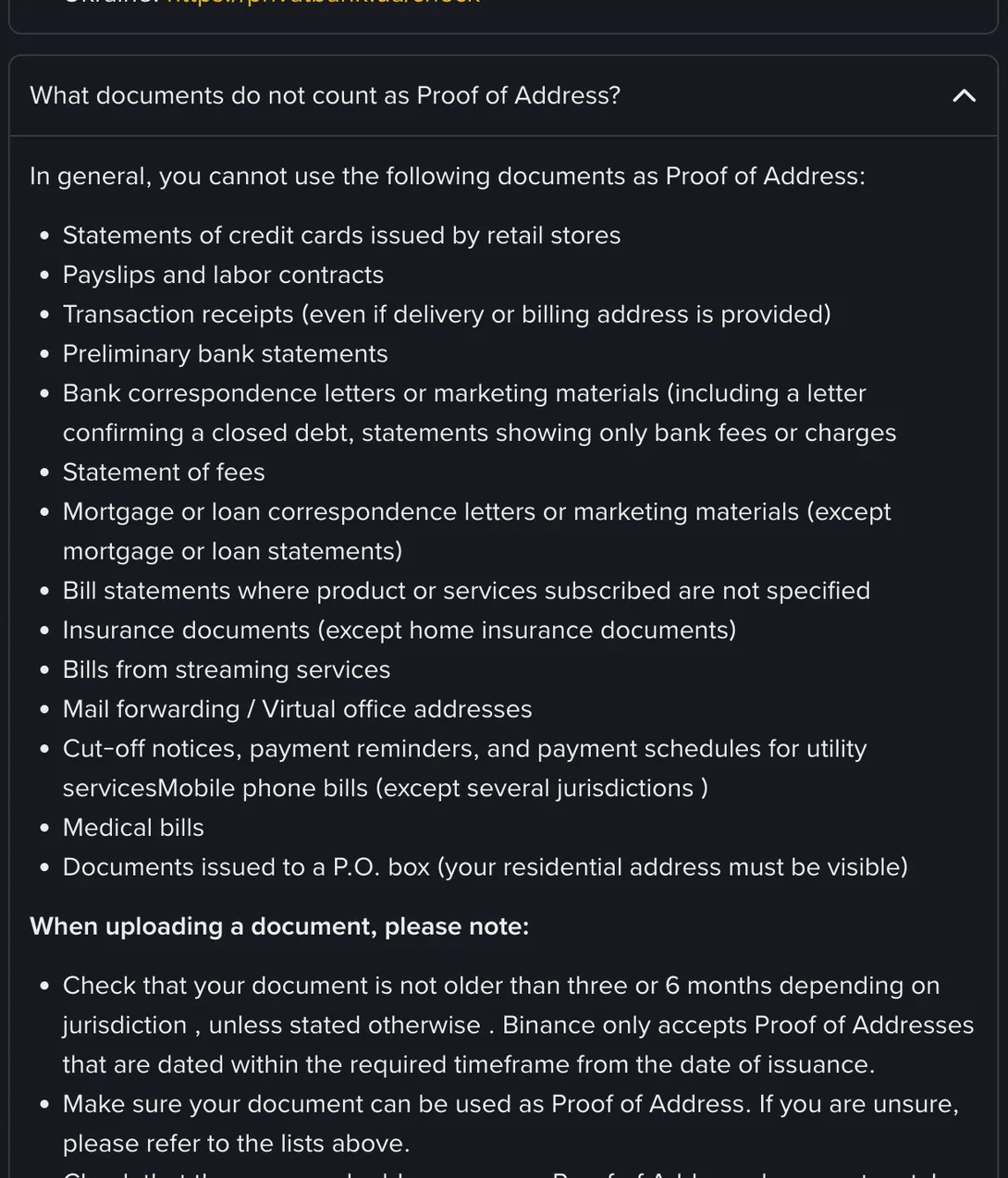
Mobile phone bills (except several jurisdictions). Written exactly like that, in brackets, on the do-not-accept list. It may be the easiest document for you to lay hands on, which is exactly why this line is worth reading first. The exception clause means it is accepted somewhere, so a post online saying one went through tells you about that person’s jurisdiction, not yours. A broadband or landline account statement from the same operator sits in a different category entirely, on the accepted side.
Documents issued to a P.O. box (your residential address must be visible). In Kenya, in parts of South Africa and Pakistan, a post office box is not an eccentric arrangement, it is how post works. That does not change the requirement. The test is whether the physical address where you sleep is printed on the document. If your bank prints both, you may be fine. If the header carries a box number and nothing else, that document is finished no matter how recent it is.
The date rule at the bottom. Under the heading When uploading a document, please note, the page says: check that your document is not older than three or 6 months depending on jurisdiction, unless stated otherwise. It really is typed that way, one word and one numeral, which tells you something about how much of this page is maintained by hand. Treat that line as the summary and the table in question one as the detail, because the table is the one with India on it.
Two smaller ones worth knowing while you are there: payslips and labour contracts are refused as a category, however completely they print your address, and insurance documents are refused with one exception carved out for home insurance.
The line to read before you upload
Everything above collapses into one pass over the document, and it takes about thirty seconds. Look at the top of page one and read across: the issuer’s name and letterhead, your full name spelled the way it is spelled on your account, the address complete down to the flat or house number, and the issue date inside your country’s window. Four things, one page, one file. Binance prefers the original PDF from the issuer; a screenshot or colour scan is also accepted if page one is fully visible and every detail is legible, but a blurry, glare-hit or black-and-white copy is not.
Read the date first and the name second. A wrong name can eventually be corrected at the issuer. A date that is too old cannot be fixed at all, so there is no point falling in love with a document before checking it.
Then upload it and put it out of your mind. Administration finishes, and the next thing you have to do about this one is nothing at all until the issuer sends the following month’s.