The boxes are unpacked, there is a new set of keys on the table, and somewhere in the second week of that comes the question: the account still says the old country. Does that matter, do you change it, and does changing it mean going through the whole verification again? Three separate questions, and the answers are not the same shape.
Three boxes, one of which is about your flat
Verification asked you for three countries at different moments, and most confusion about moving starts with treating them as one.
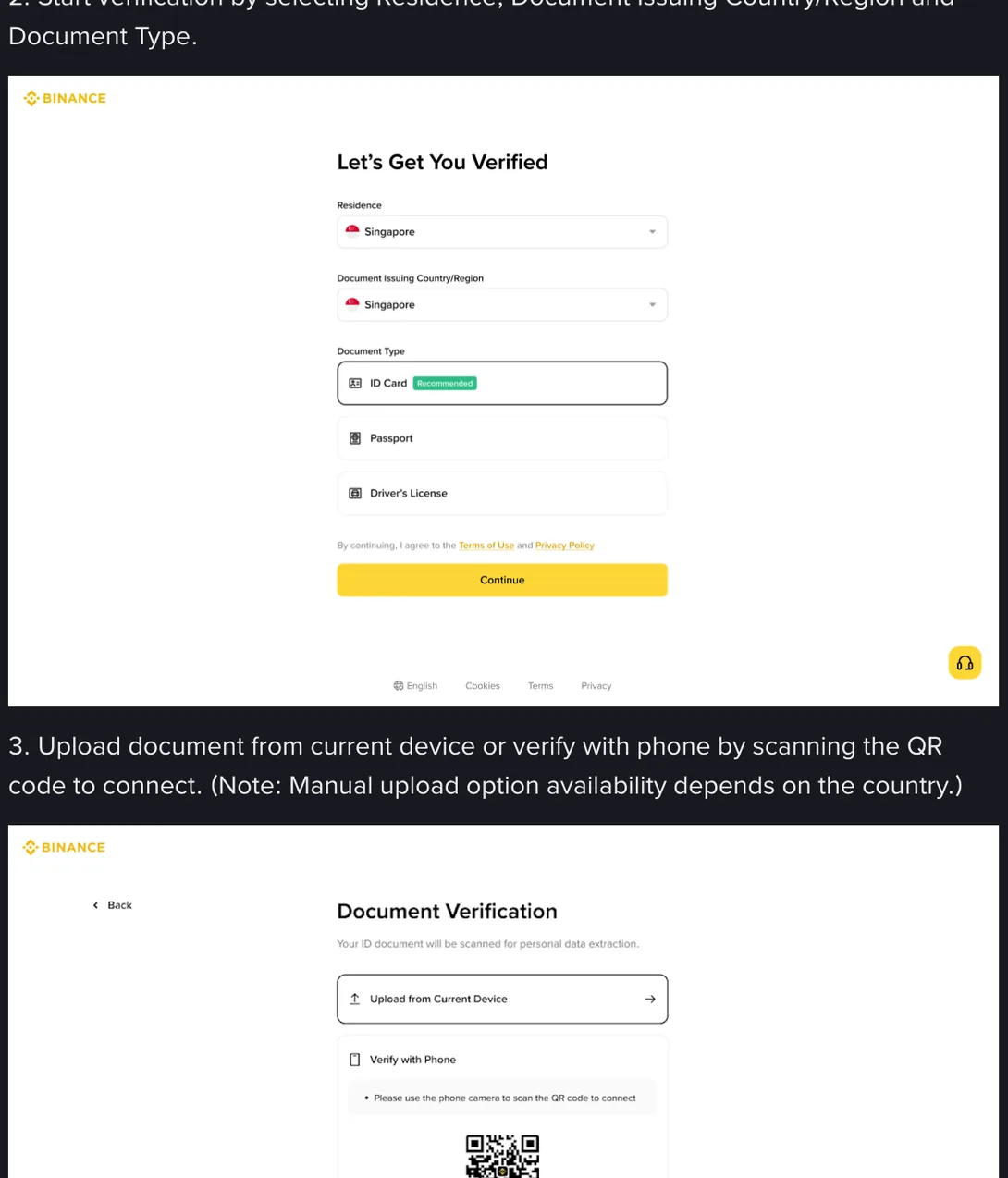
| Field | Where it appears | What moving house does to it |
|---|---|---|
| Residence | First verification screen | This is the one that becomes wrong the day you land. It decides which regional version of the rules you sit under, and it is what your proof of address has to agree with |
| Document Issuing Country/Region | First verification screen | Unchanged by moving. Your passport was issued by whoever issued it, and emigrating does not alter that |
| Nationality | Confirm Information screen, near the end | Also unchanged, unless you have actually naturalised. There is a checkbox next to it for a second nationality |
So a South African who moves to Dubai has changed exactly one of the three. An Indian graduate who moves to Melbourne has changed one. Somebody who acquires citizenship after five years has changed two, at different times, through different routes. Keeping them separate in your head is most of the work.
The reason the residence box carries so much weight is that it is upstream of everything else: which documents you are asked for, how recent they have to be, and which parts of the platform are available where you now sit.
Which of them has an update route
There is an official update route, and it is easy to miss because it is folded shut. Right at the end of the identity verification help page, under Frequently Asked Questions, question two is titled How to update/reset my identity verification information? It is collapsed until you click it, which means a browser page search will not find it. If a search tells you nothing has been written on the subject, scroll down and open the question by hand before believing it.
Click it and the condition is stated first: “If your identity information has changed and one of the following conditions is met, you can go to the [Identification] page to update.” Seven acceptable reasons follow, and the fourth of them is “The nationality has changed”. The steps start in the same place: “Go to the [Identification] page and click [Update Identity].” Read it live rather than trusting a summary, here or anywhere else; help page answers get revised, and the version showing when you are standing in a new flat is the one that governs what you can do.
So of the three boxes, nationality is the one with a clear answer, and it is not the answer people expect. It is not sealed for life. What it is not is a box you edit on a whim: the confirm screen still says you will not be able to change it once confirmed, and the route above is for information that has genuinely changed, with a document behind it. Naturalise, and there is a named path. Which fields sit behind that line, and what each one costs to move, is set out one by one elsewhere on this site.
Residence is the box I cannot close for you. None of the seven reasons is about moving house, and whether updating that field re-runs any part of the verification was not something I could confirm from Binance’s public pages when I read them in September 2026. Where the page is unambiguous is the starting point: the Identification page, on a day when the new document is already in your hands.
Where you are going matters more than the form does
People arrive at this subject expecting a form problem. Often it is a market problem instead, and the form is irrelevant because the account will not be doing much in the new place.
| Moving to | The position as of 2026-09-05 |
|---|---|
| United Kingdom | Binance stopped taking on new UK users on 2023-10-16 and is not authorised by the FCA for that market. What happens to an existing account whose holder moves there afterwards could not be confirmed from any published source on 2026-09-05, so this page will not guess at it |
| European Union | Binance ceased serving that market on 2026-07-01 |
| Philippines | Access has been blocked since 2024-03 |
| Nigeria | Naira services ended in 2024-03 and the site has been blocked to local access |
| United Arab Emirates | Residents were migrated to Binance FZE, the locally licensed entity, and asked to complete verification again under that entity’s requirements. A live example of the same account existing in a different regulatory shape rather than simply moving |
| United States, Canada, Singapore, Malaysia | Not places this account travels to. The US operates through a separate company, Canada was exited in 2023, and access is blocked in the other two |
The UAE row is the interesting one, because it is the clearest illustration of what a change of residence can mean in practice. Nothing about it was a form field. An entire population of users was moved onto a locally licensed entity and asked to verify again to that entity’s standard, which is a bigger event than editing an address line, and nothing you could have done in the dropdowns would have headed it off.
This is exactly the ground where a general page stops being useful. Whether the account survives the move turns on the licence Binance holds in your destination on the day you land, and that is revised there rather than here. Which makes this field notes rather than counsel: check the platform’s own pages for your new country before you rely on anything written above.
One practical consequence of all this. If your destination is on the list above, the account is not the thing to sort out in your first week; working out what you will actually use for fiat in the new country is. And if you are moving away from a restricted market into an open one, the whole problem may resolve itself, at which point the ordinary rules about who can open an account where are what apply to you.
Moving to India, Australia or South Africa shortens the clock
Here is the change nobody expects: the same document that was acceptable in your old country may be too old in your new one, on the same day, with nothing about the document itself having changed.
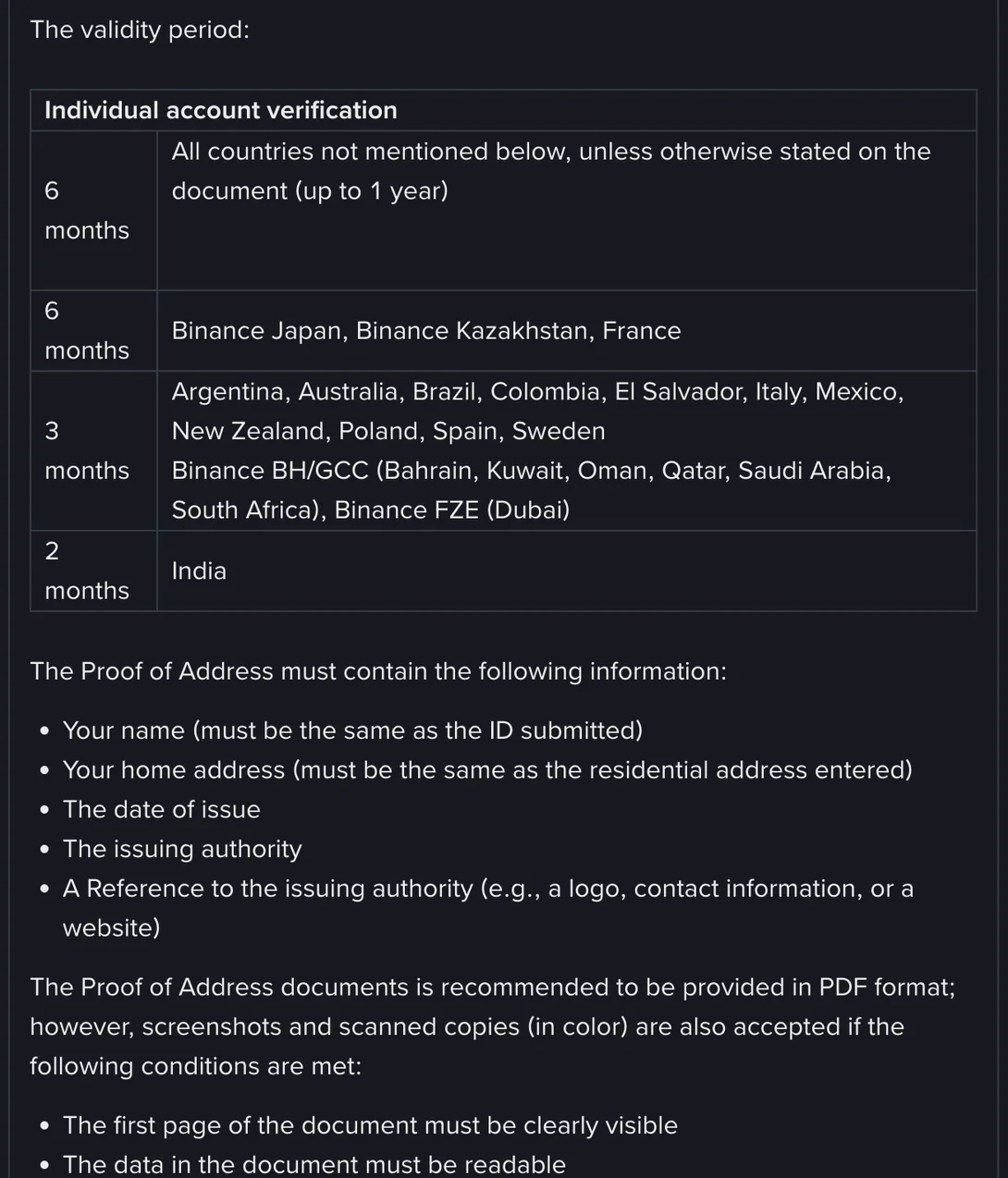
| New home | How fresh the document must be |
|---|---|
| India | 2 months |
| Australia | 3 months |
| South Africa | 3 months, listed inside the Binance BH/GCC row |
| Pakistan, Kenya, Ghana, Sri Lanka | 6 months, the default for countries the table does not name |
Two months is the shortest window in the table, so if you are moving to India, a statement you downloaded before the move may already be too old by the time you submit it. Download the new one in the week you intend to use it, and read the date printed on the document rather than the date you saved the file.
The rest of what counts as an address document, and what never does, sits on the proof of address page. The short version for someone who has just moved: bank statements and utility bills issued to the new address, not a tenancy agreement you signed with a private landlord and not a letter from your employer.
Change the address first, or move first?
This gets asked as a strategy question and it is not one. It is a supply problem.
Updating a residential address means producing a document that shows you at that address, issued by somebody with a name and a date on it. No such document exists for a flat you have not moved into. You cannot pre-emptively get a Nairobi electricity bill from Lahore. So the sequence is decided for you: land, get one service into your own name, wait for the first statement or bill to be issued, and only then go anywhere near the account page.
Which service to chase first depends on the country, but the bank account is usually the fastest of the two, because a statement can be issued within a cycle whereas a utility connection may take longer to arrive in your name than the tenancy took to sign. In a shared flat where nothing will ever be in your name, the shape of the problem changes entirely and that page is the one to read.
So put the account near the bottom of the list rather than the top: the things that unblock it, a local bank account and a bill with your name on it, all have to happen first anyway. Trying to do it in the wrong order produces a failed submission and a case in review, which is a worse state to be in than an out-of-date address line.
One warning about doing several things at once. If your passport or ID card is also being renewed around the move, do not stack that on top of an address change. Deal with the document first, then the address, then look at what is left. An expired document has a separate route and its own timing.
The week before you fly
Most of what helps is not about the address field at all, and all of it is easier to do while you still have the old country working around you. Make sure you can receive your login codes from anywhere: an authenticator app rather than an SMS to a number you are about to stop paying for, with the backup codes written down and packed somewhere you will find them. Download a copy of the documents you already have, since the old bank statement and a clear scan of your ID are useful for months. And check the expiry date on the document your account is verified against, because renewing it from abroad is a longer story than renewing it at home.
One thing the move does not touch: whatever sits inside the account is still exposed to a market that can take all of it. Crossing a border is a paperwork event, not a hedge.
Then leave the account alone until the first bill with your new address on it arrives. That is the only piece of paper the whole thing is waiting for.