The listing always has roughly the same shape. A cropped screenshot of an account page with the balance painted out, a line saying the account is fully verified and ready to use, an assurance that the documents behind it are clean, and a contact handle instead of a website. It turns up as a reply under a video about verification problems, or as a post in a group you joined for something else entirely.
Three different things get sold this way: finished accounts, a service that promises to pass verification on your behalf, and help from a person who says they work at the exchange. They come apart at different moments. The reason underneath is the same one in all three cases: verification does not attach to an account. It attaches to a face and a document, and both of those belong to a person.
What the listing is actually selling
Somebody registered an account, uploaded their own ID, and sat in front of their own camera while the liveness step recorded them. That record is what makes the account verified, and it is a record about them. When the login changes hands, none of it moves. You receive an email address, a password, and a screen that lets you in.
Three things follow from the first minute.
The seller keeps the way back in. Password resets go to the email address and the phone number the account was opened with, and those are theirs. So is the answer to any question a reviewer might ask about who this account belongs to. Buyers of second-hand accounts tend to discover this in the same week they first move a meaningful amount of money in.
The account is not yours in any sense that would help you. If the balance disappears, the argument you would have to make is that you paid a stranger for the use of another person’s identity, and there is no forum in which that argument goes well.
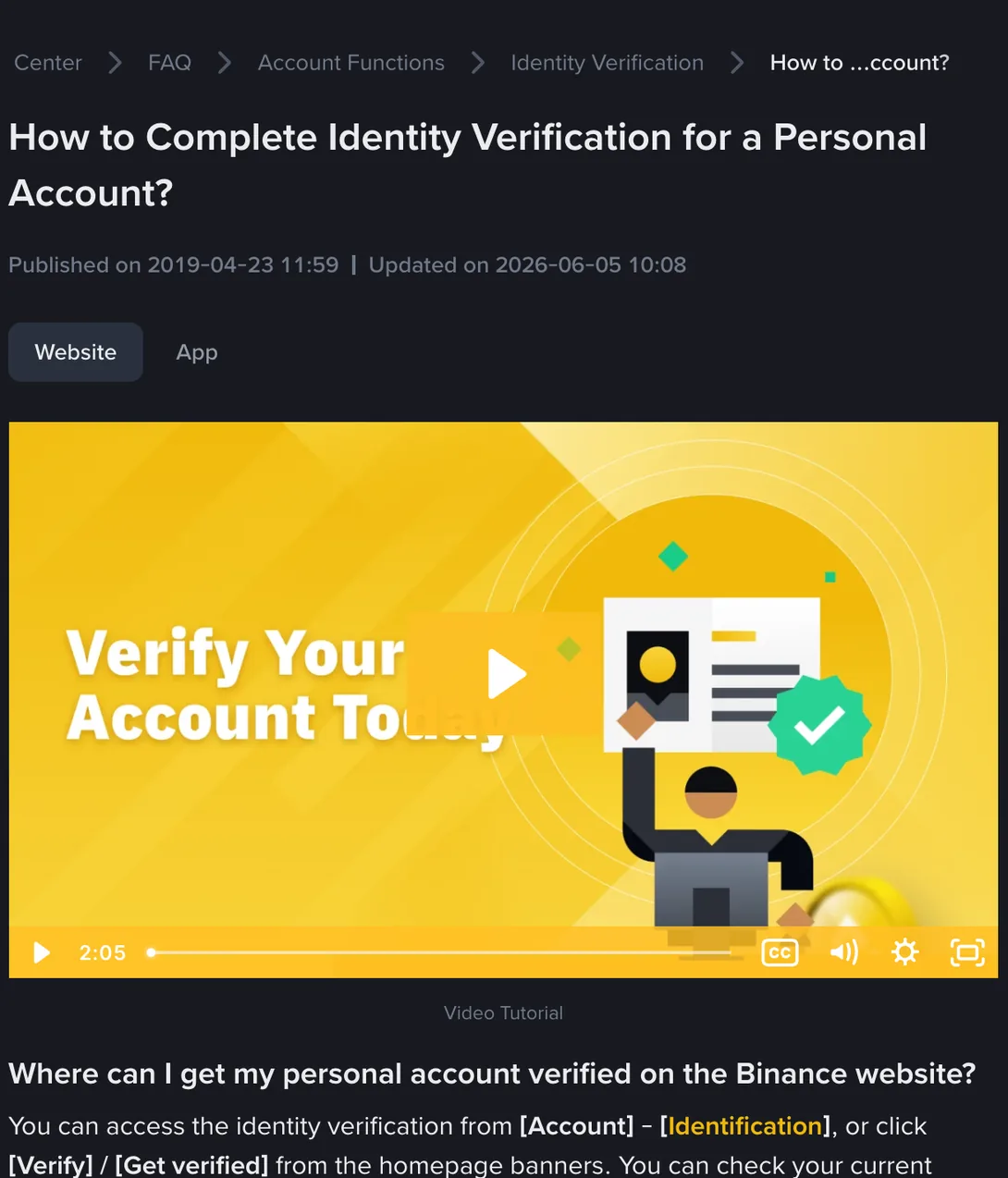
And every route into a verified account that is not this one runs through your own account page. That is what the help page describes in its opening line:
You can access the identity verification from [Account] - [Identification], or click [Verify] / [Get verified] from the homepage banners.
The other half of it is written down as well, in the second of the questions that close the same page, the one about updating your identity verification information. One sentence, under the list of reasons an update is allowed:
You cannot transfer your account to another person or substitute another person’s ID for your ID.
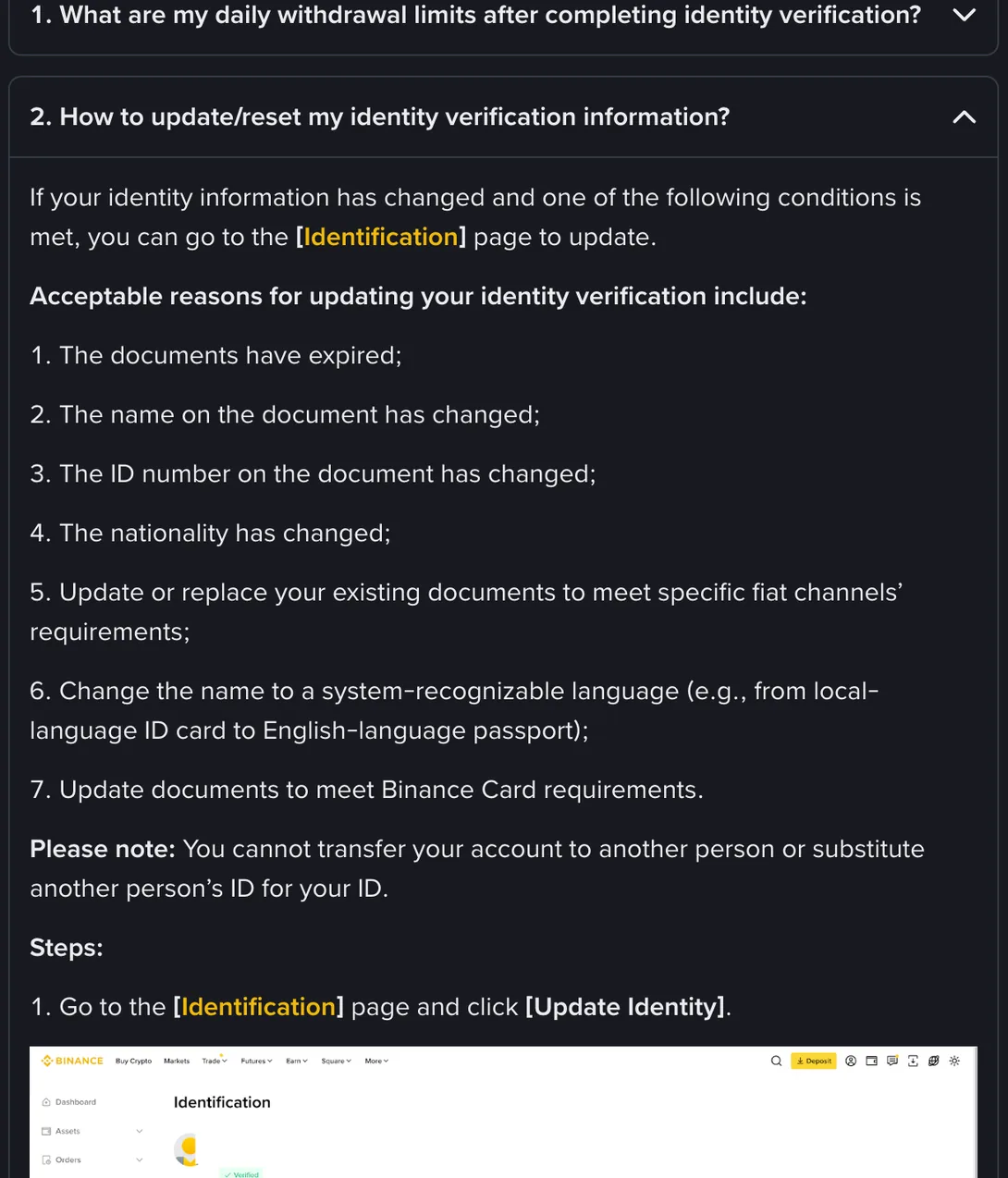
Read as a rule it sounds like a prohibition. Read as a description it is more useful: the account is a record tied to one person, and a change of login does not move the record.
The wait people are trying to buy
Very few people want a second-hand account for its own sake. What they want is to stop waiting, usually after a rejection they did not understand, and a listing that says verified, instant is aimed squarely at that feeling.
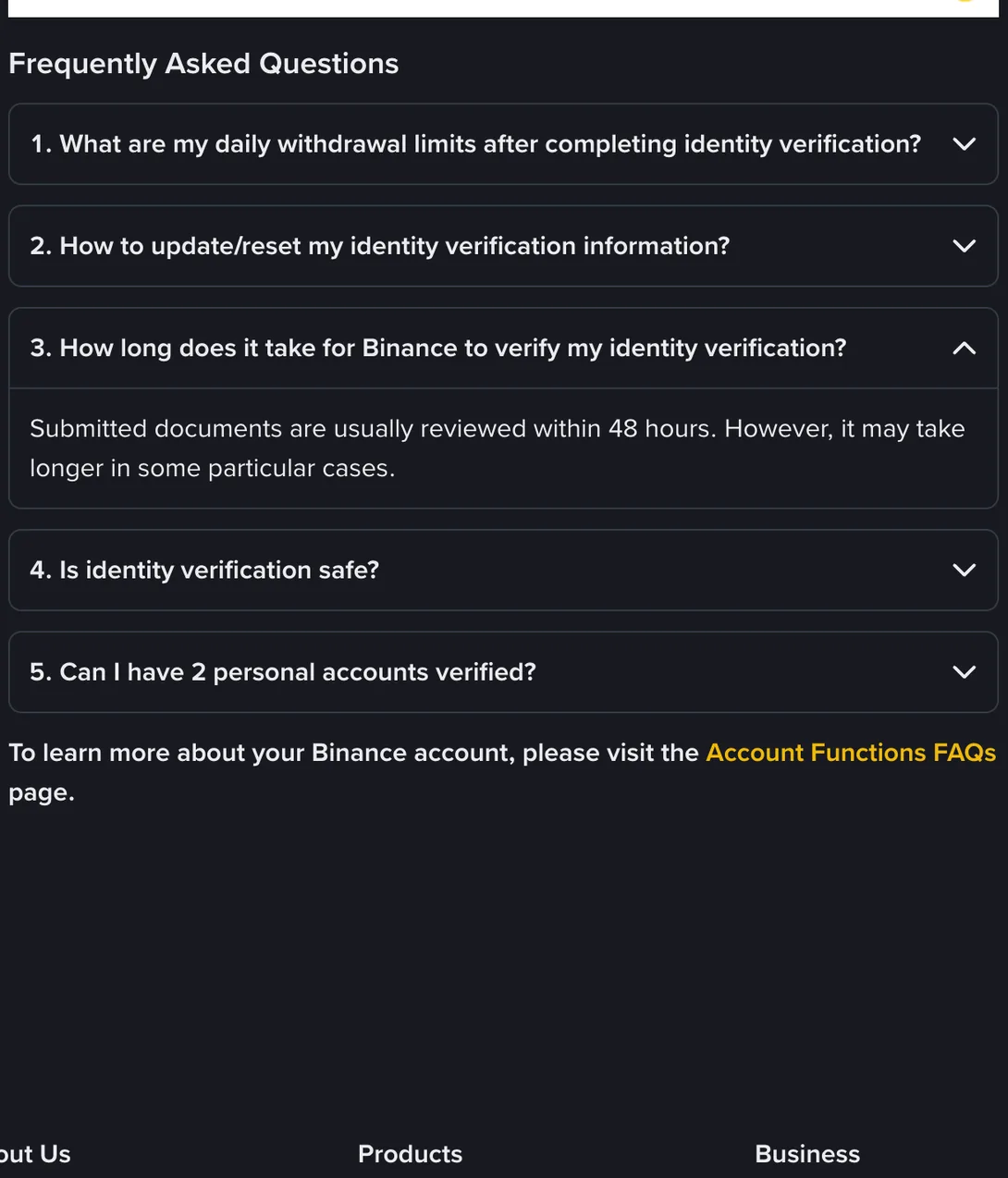
The wait is worth pricing honestly before you decide it is unbearable. Question three in that same closing list answers it in one line:
Submitted documents are usually reviewed within 48 hours. However, it may take longer in some particular cases.
Two days, usually, sometimes more. That is the thing being traded away, and the trade is a permanent problem in exchange for a temporary one.
If your case has run long past two days, that is a subject with its own page rather than a reason to go shopping: how long verification takes separates the fast automated path from the slow one.
The first time the account has to prove itself again
A bought account works fine until something asks it a question. Then the arithmetic changes in a single step.
Verification is not a one-off gate that stays open. Accounts get re-checked: on a large withdrawal, after a long gap, when the login comes from a new device or a different country, when a document on file expires. That list is how these systems are generally built rather than a Binance statement, since no help page sets out the triggers. What the re-check compares is a live recording of whoever is sitting there against the document already on record. On the website the step is a recorded liveness check rather than a photograph you upload, so a still image of the seller is no use, and neither is a photo of their card. Your face is in front of the camera. Their document is in the file.
There is one move people try at that point, and it is worse than the problem. They contact the seller and ask them to do the recording. The seller now knows the account has money in it, has been invited back into the login, and has every advantage in the conversation that follows.
Meanwhile the funds are inside an account whose registered owner is somebody else. Proving otherwise means producing a document, and yours says the wrong name.
Paid verification is either nothing or forgery
The second product is a service: pay us and we will get you verified. Every one of them opens with the same request, and the request is the entire story. Send us a photo of the front of your ID, the back, and a selfie.
Those three files are exactly what somebody needs to open accounts in your name at other places. Once they are sent, they are copied, and there is no version of the next step that gets them back.
Set that aside for a moment and look at what the service can actually do, because there are only two options. It can retype the form more carefully and reshoot the picture in better light, which is work you can do yourself with a window and a dark tabletop. Or it can change the document.
An altered document is caught by checks that never consider how convincing it looks on screen: the text layer sitting under the page image, the file’s own record of what software produced it and when, and comparison against other files that have arrived before it carrying the same template. We go through that machinery in detail in the section on bought and edited bills inside the twelve rejection causes.
A blurred photograph is a resubmission. A document judged to have been fabricated is a different kind of case, and no help page anywhere promises a route back from one. Paying a stranger to move you from the first category into the second is the worst value in this whole subject.
Nobody from support will ask for your code
The third product does not advertise. It finds you.
You post somewhere public that your verification was rejected, or that a withdrawal is stuck. Within the hour a reply or a private message arrives from an account carrying the platform’s name and logo, sympathetic, in a hurry to help. The asks escalate in a fairly reliable order: your registered email address, then a screen share so they can see the error, then the six digits that just arrived on your phone, then a photograph of you holding your ID up beside a handwritten note with today’s date on it.
Two things kill all of it.
First: a verification code is the second half of your password. It exists so that knowing the password is not enough. Reading it out to a helpful person converts your account into their account, immediately, and it does not matter how the request was worded. There is no legitimate reason for any human being to need a code that was sent to you.
Second: the verification flow on the website ends with a recorded liveness check. There is no screen in it that asks you to hold your card up beside your face for a photograph, and no screen that asks for a handwritten note. When somebody claiming to be a verification specialist asks for one, they are asking for the raw material of an identity theft, dressed as a procedure. That is the whole subject of the page on handheld ID photos, including the platforms where such a photo genuinely is part of the flow.
Support conversations start from inside the app or the website, opened by you. That single habit removes most of this class of problem, because it means an unsolicited message is a signal on its own, before you have read a word of it.
Not getting your verification code?
This section exists because the moment a code fails to arrive is the moment people start accepting help from strangers.
The ordinary causes are dull. Delivery of one-time SMS across international routes is uneven; it varies by country, by network and by time of day, and no figures on that are published anywhere solid enough to quote, so this page gives none. Beyond the network there are the boring ones: a registered number you stopped using, a phone roaming, a spam filter, a promotions tab, a full mailbox, or a code that did arrive while you were requesting a second one.
| What is happening | What to do about it |
|---|---|
| Email code missing | Search the mailbox for the sender rather than scrolling; check spam and promotions; add the sender to contacts so the next one lands in the inbox |
| SMS not arriving | Let the countdown finish before asking for another. Each new request can retire the one already in flight, which is why the fourth attempt often works no better than the first |
| Number changed or lost | Deal with it through account recovery, not through a new account. A second account verified with the same document is the exact thing the checks are built to catch |
| Codes keep failing at the last second | If the platform offers an authenticator app, move to it. The code is then generated on your device from a shared secret and never travels over a network at all |
Move your codes to an authenticator app in the first week rather than during an emergency; once it is done, SMS delivery stops being something you have to think about. Write the backup codes on paper while you are there. It removes a whole category of problem, and with it the panic that makes the next paragraph possible.
Because whatever the reason is, the rule at the end of it does not bend: a person asking you to forward a code to them is running a scam. Support, a friend of a friend, an agent with a badge in their profile picture, someone who says the code needs to be verified from their side. All of them. There is no exception hiding somewhere in this that you have not thought of.
Where you live decides part of this too
Using another person’s identity documents, or handing your own over so that someone else can use them, is treated as an offence in a lot of places, quite separately from anything a platform’s terms say about it. The two consequences run in parallel and the legal one does not care that the account has been closed.
What that amounts to for you is written in your own country’s criminal law rather than in anybody’s terms of service, and it is amended there too. So this page is not going to name a consequence, and none of it is legal advice; be sceptical of any page that offers you a firm one.
There is also somebody else in the story who never agreed to any of it. The documents behind a resold account belong to a real person, sometimes one who was paid a small amount for the use of their ID and was never told what it would be used for. When that account is later frozen, their name is on the file.
No shortcut, but two things that save real time
If you are reading a listing for a verified account after a rejection with no reason attached and a few attempts that changed nothing, stop here: the listing is selling certainty. The certainty is the fake part.
Two things genuinely shorten this, and neither of them costs anything. Getting the documents right before you begin, rather than discovering mid-flow that the bill is in your father’s name, is covered in what to prepare before you open an account. Knowing which screen fails, and what it is failing on, is the screen-by-screen page. Between them they take an evening, and the evening is yours rather than a stranger’s.
One last thing to keep in proportion while you are being patient with a form. The account is a piece of admin, and admin gets finished. What sits behind it is not: crypto prices swing hard, the whole of a balance can go, and a verified badge changes nothing whatsoever about that.