A few minutes of form-filling. That is the part everybody plans for. The week people actually lose is spent somewhere else entirely: hunting for a document that turns out to be expired, waiting for a bank statement that has to be requested at a branch, discovering at eleven at night that the only bill in their own name is a mobile bill, which is the one kind that usually does not count. None of that is the form’s fault. It is a packing problem.
So this page is a packing list rather than a walkthrough. Get these things onto one desk, and the run through verification stops being a series of interruptions.
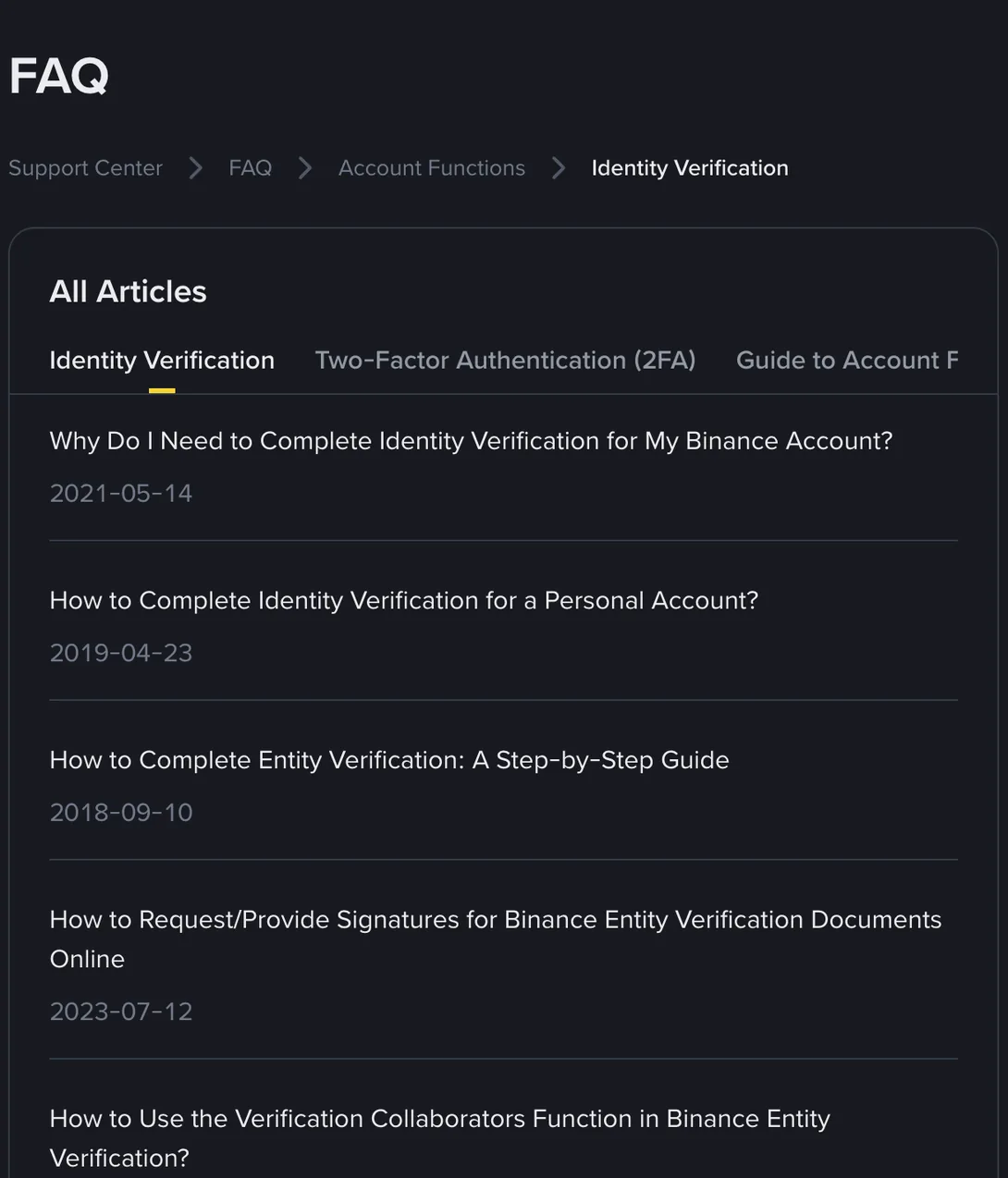
The document your country’s flow will take
Verification asks you to pick a document type after you have picked your residence and the country that issued the document, and the list you are offered depends on that issuing country. So the useful question is not “which document is best”, it is “which one does my country actually put on the menu, and which of mine is in the best condition”.
| Where you live | What the flow generally takes |
|---|---|
| India | Aadhaar and PAN are what everyone reaches for. Which of passport, licence and card the flow lists, read off your own screen after choosing India |
| Pakistan | The CNIC. It is the ID card option |
| Australia | Passport or driver licence. There is no national ID card to reach for |
| South Africa | The Smart ID card. If you still hold the green barcoded book, replace it before you start rather than during |
| Kenya | The national ID card, or a passport |
Two conditions apply to whichever you choose, and they are checked before anyone looks at your face: it has to be current on the day you submit, and it has to be the physical original. Photocopies, scans and photographs of a screen all carry the marks of being second-generation files. Turn the document over and read the expiry line now, at the packing stage, because a surprising number of people meet their expired passport for the first time at exactly the wrong moment.
Read the table as a starting point rather than a rule. The menu of document types is built from the issuing country you pick and from what Binance is asking of that country on the day you go through it, and menus get rebuilt without an announcement. Nothing here is legal or investment advice.
If two of your documents disagree with each other, that disagreement is the thing to fix first. An Aadhaar spelling one way and a PAN spelling another, a passport with a blank surname line and a driving licence that filled it in: whichever you upload becomes the standard that every later document is measured against. Choosing between them by country goes through that in more detail.
A number that receives texts and an inbox you open
The sign-up screen takes either an email address or a phone number, and whichever you give it is where the code goes. Both should be things you use this month, not an address from a previous job or a number on a SIM in a drawer.
Email travels better across borders, which matters if you move country or change operator more often than you change inbox. A phone number is faster and less likely to be filtered into a spam folder. Neither is wrong. Pick the one you are less likely to lose access to in three years, since it will be attached to account recovery for as long as the account exists.
Two more things belong in this part of the pile, and both take seconds if you do them now and feel impossible if you leave them: an authenticator app already installed, and a piece of paper. The screen that turns on two-factor authentication shows a set of backup codes once. Copy them onto the paper before you click past it. Storing them in the same phone that holds the authenticator solves nothing, because a lost phone takes both.
The phone, and why the camera step prefers it
You want a phone with a working front camera within reach, even if you are doing everything else on a laptop.
Part of that is the liveness check, which records video of your face and, as Binance’s own screen says, your background along with it. Part of it is the upload screen, which offers to hand the document photography over to your phone by way of a QR code. One workable split is to do the camera steps on the phone and read the confirmation page on the computer, because a small screen is a poor place to check a long address character by character. That is a suggestion rather than a rule.
Whatever you use, sort the room out before you start: a window in front of you rather than behind, no overhead lamp bouncing off the lamination, and a dark matte surface to lay the card on. Those three things decide whether the numbers on your document survive the trip.
Address proof: have it, don’t volunteer it
This is the part that surprises people, so it is worth stating plainly: prepare an address document, but only upload one when a screen asks you for it. Proof of address is part of the identity verification process in Binance’s description of it, and when it gets requested varies with country and circumstance. Volunteering documents that were not asked for does not speed anything up.
What counts as one is a document showing your full name, your residential address, the date it was issued and who issued it. Utility and service bills, bank and financial statements and government-issued documents are the three families Binance groups them into. Mobile phone bills sit on the not-accepted list except in a few jurisdictions, which is a cruel detail if a mobile bill is the only bill you have; a landline, broadband or TV package bill is on the accepted side of the same list. The full breakdown by type is in what actually counts as proof of address.
Then the part that quietly voids documents people already have: how recent it must be.
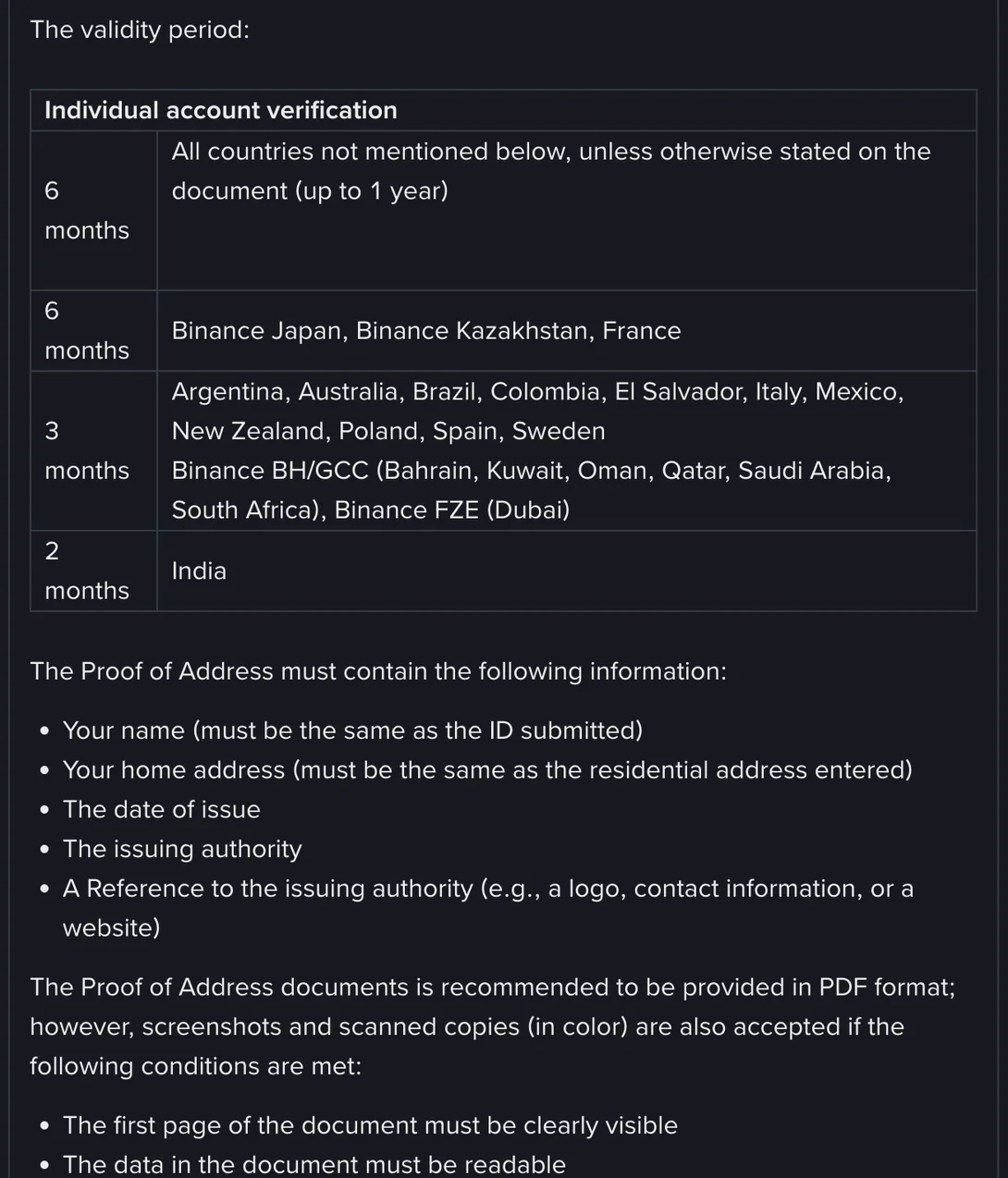
| Where you live | Document must be no older than |
|---|---|
| India | 2 months |
| Australia | 3 months |
| South Africa | 3 months, listed inside the Binance BH/GCC row |
| Pakistan, Kenya | 6 months, the default for countries not named on the table |
Two months is short. If you are in India, this is an argument for downloading the statement in the week you need it rather than reusing the one saved in spring. And the clock runs from the issue date on the face of the document, not from the day the PDF landed in your downloads folder.
Spell your name the way the document spells it
Before you open anything, look at how your name is printed on the document you are going to upload, and decide that this is the spelling you will use. Not whatever your degree certificate says, not the version an airline booking uses, and not the one you would choose for yourself.
Take extra care here if your name was written in Urdu, Arabic, Devanagari or Sinhala first and transliterated afterwards. Mohammad, Mohammed and Muhammad are the same person to you and three different strings to a checker. The same goes for names that do not fit the First, Middle, Last shape the form expects: a single-word name, a South Indian initial standing in for a father’s name, an Arabic name in four parts. If you are working from a passport, use the passport’s own answer, since the data page already splits surname from given names.
Have the date of birth ready in the right order too. A card printing 05/09/1994 is saying the fifth of September almost everywhere in South Asia and East Africa; the confirmation screen wants year, month and day picked separately, and that is where a birthday quietly changes date. Several of these fields cannot be edited once you confirm them, and which ones those are is worth reading before rather than after.
How much time should you set aside?
Two official numbers get quoted at each other constantly, and they answer different questions.
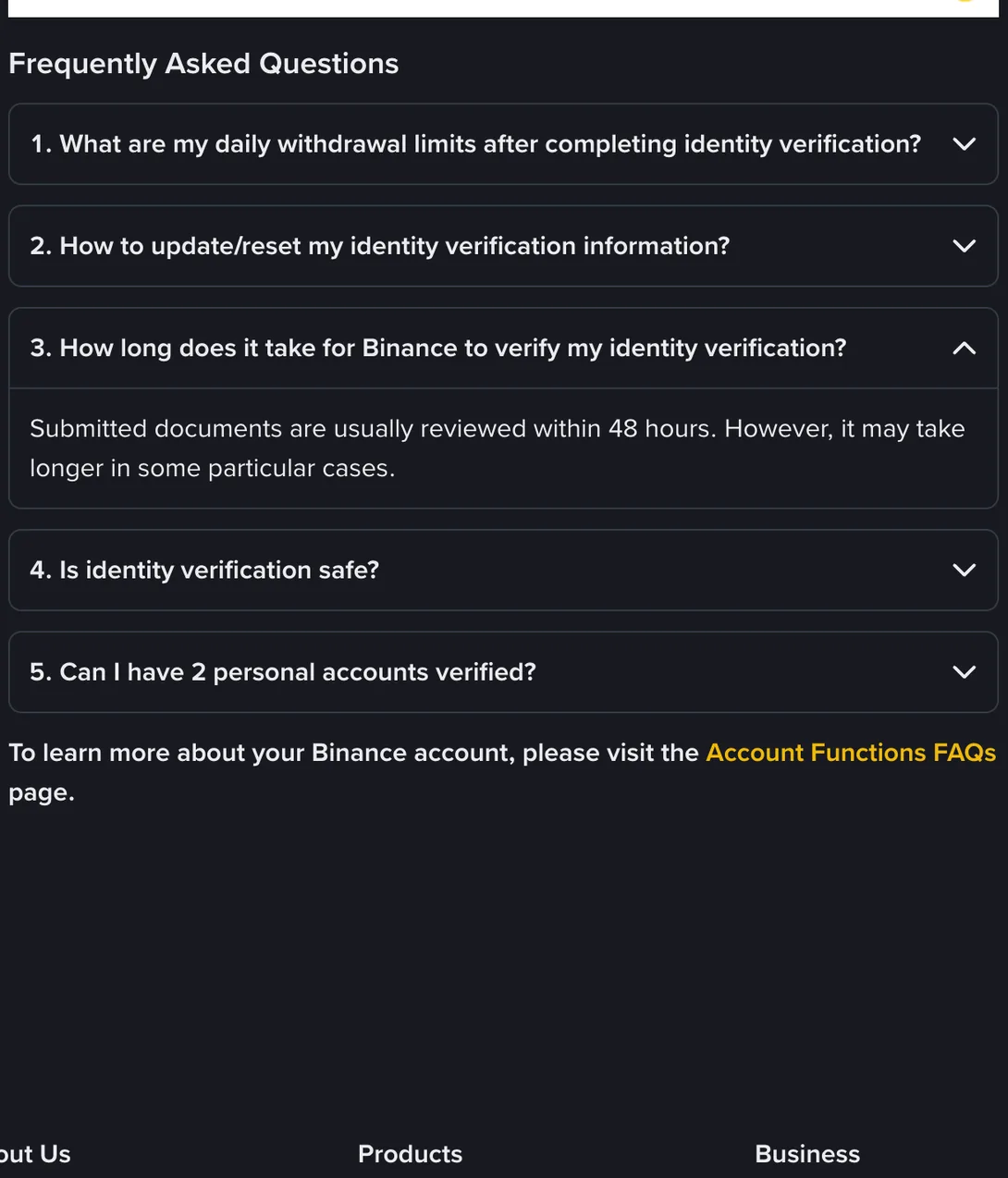
The first is on the screen you see after submitting: Under Review, with an Estimated time of 15 mins beside it. That is the interface estimating your case, not a promise. The second is in the frequently asked questions at the foot of Binance’s personal account verification page, third item, which reads: “Submitted documents are usually reviewed within 48 hours. However, it may take longer in some particular cases.” Neither number is wrong and there is no average of them worth calculating, because they describe two different routes through the same process. The waiting page takes that apart properly.
For planning purposes: the part that belongs to you, filling in fields and photographing things, wants an unhurried half hour of decent daylight. The part that does not belong to you starts when you press submit, and you cannot schedule it. So do not start this at midnight the day before you need the account.
When you have all of it in front of you
Document, phone, inbox, address file, a lit room and the name spelled out. That is the whole list.
At that point, open the sign-up page from a link that already carries a referral code rather than keying one in anywhere, because the first screen has no field for one. This one carries ours. Said plainly: BNB6606 is a referral code, not a discount code. It gives you no fee discount and costs you nothing extra, your fees are whatever Binance charges anyone else at that moment, and the only thing it does is tell Binance the sign-up came from here. There are also places where it earns us nothing whatsoever, UK retail users, Nigeria and Binance FZE accounts in the UAE among them, and your side of it is identical either way.
If you would rather work from a list built around your own situation, the verification checklist builder takes your country and document type and returns the documents that apply to you, including how recent the address proof has to be where you live. It runs in your browser and nothing you type goes anywhere.